
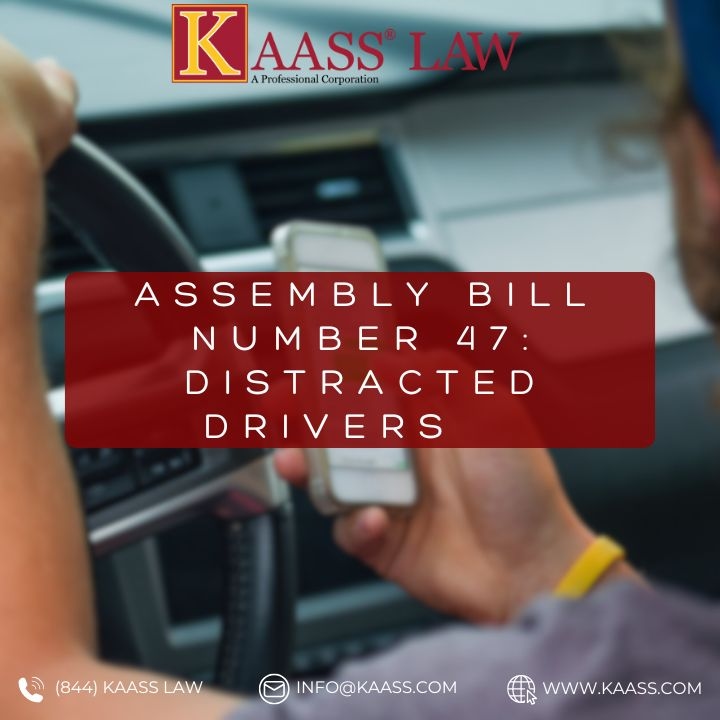
Attention always competes for multiple inputs with smart devices and, along with text messages, emails, and calls coming in. With technology comes convenience, but there is no doubt that it has elevated the level of distracted driving on our roads. California as a state has had its fair share of accidents since people are not mindful of their surroundings while driving. Assembly Bill Number 47 (AB 47) marks an important development in California's longstanding battle with distracted driving. At KAASS LAW, we cover cases of distracted driving and legal disputes related to it. Additionally, at the same time, we are advocates for road safety. The following will shine a light on AB 47 and what it means for drivers in California.
Ignoring the issue of distracted driving is closer to ignoring danger altogether; it accounts for a large number of road traffic accidents, injuries, and deaths. People are so wired up to their phones that all the actions listed above are deemed socially acceptable. All of these interfere with reactions, the ability to focus, and attention. Each one of them is bound to increase the time taken to respond to changes on the road. Given the seriousness of the problem, lawmakers in California have always been in search of ways to encourage people to consider relinquishing their stranglehold on distractions when driving.
Assembly Bill Number 47, signed into law, specifically targets repeat offenders of California's hands-free cell phone law. While the state already prohibits holding and using a cell phone while driving (with limited exceptions), AB 47 aims to increase the penalties for drivers who repeatedly violate this law within a 36-month period.
AB 47 underscores the seriousness with which California views distracted driving. It sends a strong message that repeated violations of the hands-free law will not be tolerated and will have tangible consequences for a driver's record and driving privileges. This law has several important implications:
While AB 47 specifically targets handheld cell phone use, it's crucial to remember that distracted driving has a range. Any action that diverts a driver's attention from the primary task of operating a vehicle safely can be dangerous. This includes:
While AB 47 focuses on handheld cell phones, drivers should be aware that engaging in other forms of reckless or negligent driving due to distraction can still lead to traffic tickets, accidents, and civil liability.
If you have been injured in a car accident caused by a distracted driver, you have the right to seek compensation for your injuries and losses. At KAASS LAW, serving various communities throughout California, our experienced personal injury attorneys can help you:
Alternatively, it is worth mentioning that distracted drivers are one of the most dangerous drivers for a motorist.
Car accidents, unfortunately, happen every day and cause damages to both the vehicle leading to negative economic consequences to drivers but also their life and health. Car accidents are caused by different reasons such as hydroplane car accidents, accidents involving elderly drivers, and ordinary accidents happening because of the negligence of the drivers. One of the types of car accidents is defective tire accidents.
Manufacturing defects are related to such issues, which, arising during production, make the tire differ from particular specifications.
Design defects are considered to be in place if the tire doesn't perform as safely as it can be expected by an ordinary customer and place risk of danger on the latter.
In the case of the manufacturer, the designer does not provide instructions, safety warnings to the use of the tires and lead them to cause damages, it is considered that the tire had a warning defect.
While a swimming pool is one of the best places to enjoy your weekend, it can become a risk for you and also the owner of the pool if an drowning accident happens.
You can file a lawsuit for the drowning accident in case the swimming pool does not comply with the safety requirements of the state or in case the lifeguards were negligent and, as the result of such negligence, the accident happened. The owner of the pool can also be liable in case the lifeguard it hired was not qualified for the performance of job duties.
Upon filing a lawsuit for negligence arising out of a drowning accident in California the Plaintiff is required to prove the following:
Getting compensation for medical bills and expenses is the first thing that comes to anyone's mind after an suffering injuries from an auto accident. Usually, the at fault party responsible for the accident or the injuries should be liable for your medical expenses. However, they do not usually pay compensation immediately after the accident. To better understand the medical bill's compensation process, let's examine it part by part.
As discussed, the liable party or their insurer is responsible for your medical bills, but they typically don't compensate immediately. If you're waiting for a settlement or trial, your insurance company—private or government—can pay your bills. However, there are also common causes, when the injured party does not have health insurance.
The legal regulations allow giving discount or payment plans to uninsured parties or to any person "whose income does not exceed 350% of federal poverty level" Another option is "medical lien". It lets the healthcare provider receive payment from the personal injury case's judgment or settlement. This mechanism lets the patient pay after resolving the case. However, few hospitals or medical organizations will agree to this scheme, as they risk not receiving payment if the case fails. This scheme can also be risky for you as if you do not succeed with your case, you shall be liable for the remaining part of the expenses. If you have insurance but doubt whether you should use it or give a medical lien, it is recommended to use the insurance. If you use it, the medical help providers cannot charge you in full rate, exceeding your contract rate. Also, in the case of insurance, you have more options for healthcare providers to choose from. To sum up, choose your insurance unless you lack it or your insurance doesn't cover the services you need.
Have you ever heard of card rooms; state-run lotteries? Have you ever wondered whether California considers horse race wagering legal? This article will provide an overview of existing gambling regulations.
Though there is no certain definition for gambling under California State Law, the practice shows that the following elements shall be present to qualify the actions as gambling:
The California State Constitution considers gambling illegal in California. However, some types of gambling are exceptions to the general rule. Particularly, California law permits:
The main legislative act regulating gambling in California is called Gambling Control Act. This act sets out the relevant licensing terms for the entities, which are involved in the gambling market. California Gambling Control Commission issues particular regulations for gaming licenses. Besides, it also issues licenses to owners, supervisors, players, and employees of gambling institutions. It is considered that licenses shall be renewed bi-annually and they may not be assigned or transferred in whole or in part under California Business and Profession Code. This means that a separate application for receiving a license must be submitted for there to be a change in corporate control of the licensed entity. California allows tribal casinos, and the state and the tribe negotiate their regulations. The regulations will cover revenue sharing details, licensing terms, and other related matters.
In California, when a spouse dies, the surviving spouse generally has the right to transfer assets and property in their name but there are exceptions. First, the surviving spouse would need a certified copy of your spouse's death certificate and certificates of marriage to show that you married the deceased.
California is a community property state, as such upon the death of a spouse, the surviving spouse is entitled to one-half of the community property. Pursuant to California Family Code section 760, community property is defined as “all property, real or personal, wherever situated, acquired by a married person during the marriage while domiciled in the state.” At the end of a divorce, community property is generally split 50/50.
In California, if a spouse dies intestate, meaning there is no will or trust, then surviving spouses may inherit half of the community property, as well as, one-half of the deceased spouse's separate property.
In California you generally cannot disinherit a spouse unless, your spouse waived such rights to inherit from you in a valid, signed agreement, known as a "pre-marital agreement".

Pursuant to Penal Code 20410 PC it is unlawful to:
Let’s examine the following scenario: Your friend gives his belt buckle knife to you in order to keep it in your house for 4 days. You are aware of what the instrument it is. Since, you knowingly agree to keep the belt buckle knife, this means that the item is in your possession and that you have control over it. Thus, authorities may charge you under Penal Code section 20410 PC.
California law prohibits weapons such as wallet guns, firearms mounted or enclosed in a case, lipstick case knives, knives in lipstick cases, and belt buckle knives. Under the above-mentioned section, a belt buckle knife is " a knife, which is an integral part of a belt buckle and consists of a blade with a length of at least two and one-half inches. Generally, the law allows certain people, such as law enforcement officers or antique dealers, to possess belt buckle knives.
Creditor creates a judgment liens on real property by registering an abstract of a money judgment with the county registrar. It can apply to real or personal property, including jewels, art, antiques, and other valuables.
California law regulates the lien judgment. A title search revealing a judgment lien means the judgment creditor has registered a Judgment Abstract in the debtor's district.
To get the debtor's judgment on California property, a creditor must mail or take the Abstract of Judgment to the county registrar's office in any California county where the debtor currently owns property or plans to own property in the future. An abstract of judgment is a written summary of a judgment, showing the amount the losing party pays to the winner, the interest rate, court costs, and any special orders to follow. If the lien will attach to personal property, the creditor must file the Abstract of Judgment notice with the California Secretary of State. The lender may also notify the debtor of an examination.
Bump stocks laws are considered to be illegal both under federal law since March 2019 and under California law.
A bump stock is described as:
Thus, with the help of a bump stock, a shooter can shoot almost as fast as in case he uses an automatic firearm. Though it shall also be noted, that bump stocks do not convert semi-automatic guns into automatic ones.
The actions, which are considered illegal, are the following ones:

In order to understand the limitations of the law, it is essential to first understand what is an imitation or fake firearm. The imitation firearm is described to be a device, a toy gun, a replica of a firearm that is
Thus, this is a device that looks really similar to a real firearm and can make the person believe and fear its harm.
Penal Code 417.4 PC is the California makes it a crime for a person to: (1) draw or brandish an imitation firearm in a threatening manner; (2) such that it causes a person to fear bodily harm for himself or another person; and (3) it was reasonable to fear the harm. To convict a defendant for brandishing a weapon or firearm under Penal Code 517.4, the prosecutor must be able to establish the following:
As discussed above, if it is believed that the case of an accident arose out of a defective tire, the liable party of said accident may include:
Generally, to prove that the defect of a tire was the reason for the accident, an qualified expert would testify in the form of expert testimony. Common examples that the expert would need to testify to includes:
You shall also prove that you used the tire in a foreseeable manner and the defects occurred before your use of the vehicle. Expert's opinion shall also assist you with this evidence.
Family members are entitled to file such lawsuits and receive compensation. The family members having such rights are:
Other common losses
Compensation in a defective tire lawsuit can include the following:
The defendant can bring different arguments supporting his position, such as that the tires were affected not by his fault but by your negligent use. For this reason, it is essential to receive professional assistance and consult an experienced attorney.
If you or a loved one has been in a defective tire accident, contact our Los Angeles Personal Injury attorney at (310) 943-1171 for a free consultation and case review. Our attorneys will evaluate the details of your case and let you know what to expect and how you can proceed.
Family members can file a lawsuit, such as:
The above-mentioned family members can sue if the accident does not kill the victim but leaves him unable to protect his rights.
While filing the lawsuit, you can seek compensation of:
In case you file a lawsuit for the wrongful death of a family member, you can seek compensation of:
In case you had a drowning accident, try to gather evidence, as:
In California, pool owners are required by law to keep their facilities safe. This means installing:
And other items required by law. For example, the California Swimming Pool Safety Act requires residential properties with swimming pools to install safety barriers. Failure to do so can make the owner liable for damages. Especially if the victim is a child. Failure to comply with safety standards may be considered a failure to exercise due care. This opens up the possibility of a lawsuit.
In legal terms, negligence means that the defendant failed to exercise reasonable care under the circumstances. In a drowning case, this could mean that:
Even if the victim was on private property without permission, the owner can be held liable. But only if it is proven that he or she knew of the danger and failed to take appropriate action.
If the drowning occurred at a municipal pool or on property managed by a government entity, special procedures may apply. In California, to file a lawsuit against a public entity, you must first file a government claim. Within six months of the accident. Failure to meet this deadline may result in the loss of your right to sue.
Even in case you signed a waiver for liabilities, or the defendant argued that there is the "assumption of risk"-an inherent risk present while swimming, you can still expect to receive compensation if you have an experienced attorney. We invite you to contact KAASS LAW firm at (310) 943-1171 for a free consultation and case review by a Glendale personal injury attorney.
Medical expenses after a car accident can include a wide range of services. For example, they may include not only the initial hospitalization, but also subsequent recovery:
In the case of serious injuries, there may also be long-term costs, including:
In a personal injury case, it is possible to seek compensation for anticipated future medical needs. To do this, you will need to provide a doctor's opinion as to the length and cost of treatment. For example, if the injured person will need surgery six months after the accident, his or her attorney can include that amount in the claim.
In such a case, the injured person has the right to file a civil lawsuit against the driver or other responsible parties personally. Alternatively, you can use your underinsured motorist coverage, if available. However, this can be difficult in practice if the defendant does not have enough assets to cover the claim.
The statute of limitations in California personal injury cases is two years from the date of the accident. If you miss this deadline, you may lose your right to compensation. It is important to start the process early in order to preserve all evidence and file a timely claim.
Insurance companies have subrogation rights for a personal injury claim. Subrogation right means that your insurance company can recover your medical expenses from the party who was liable for the injuries. Your insurer shall also have the right to sue the liable party on your behalf.
Claiming compensation for medical expenses is not an easy process. You still need a professional attorney to assist you with evaluations of your case, negotiations for a larger settlement. Professional legal assistance is crucial if you seek compensation for pre-existing injuries that worsened as a result of the accident.
The attorneys at KAASS LAW have extensive experience handling auto accident and medical expense cases. We can help you accurately calculate all of your costs and properly file a claim for compensation. Call us at (310) 943-1171 to schedule a free consultation and start protecting your rights.
Horse wagering, including pari-mutuel wagering, falls under California Horse Racing Law and the California Business and Professions Code. The Californian Lottery runs the only authorized lottery in the state of California.
Under Penal Code 330 PC it is a misdemeanor offense to:
The minimum age to gamble in California is 18 years, though some casinos have a minimum age of entry which is 21 years.
California does not separately regulate online gambling. Thus, there is no special licensing regime for online gambling.
Businesses and individuals engaged in gambling activities in California are subject to strict state regulation. The California Gambling Control Commission has the authority to impose administrative sanctions for violations of the Gambling Control Act. Such sanctions include:
Liability applies to both licensees and employees of gambling establishments. Individuals involved in illegal gambling activities may also be subject to criminal penalties. Under California Penal Code Section 330 PC, it is a misdemeanor to:
This offense is classified as a misdemeanor and may result in a fine, arrest, or other sanction as determined by the court.
It is also important to note that third parties, including landlords who provide the premises, can be held liable. The California Business and Professions Code considers advertising illegal gambling a misdemeanor. While advertising for legal gambling activities is not prohibited, it must comply with general advertising requirements. These include a prohibition against misleading information. Authorities may impose fines and take civil action if parties fail to meet these standards.
The California Gambling Control Commission, Horse Racing Board, and Lottery Commission have not issued separate acts regarding gambling advertisements. Thus, the California Business and Professions Code regulates gambling advertisements under its general advertising regime. If you or a loved one would like more information on California wagering and gambling laws we invite you to contact KAASS LAW (310) 943-1171 today. The sooner you come forward, the better chance you have of successfully resolving your case.
For more information regarding the rights of a surviving spouse or probate in California, we invite you to contact a California probate attorney at KAASS LAW today at (310) 943-1171.
The offense is a wobbler, meaning prosecutors can charge it as either a felony or a misdemeanor, depending on the case facts and the defendant's criminal history.
Penalties for a misdemeanor Penal Code 20410 conviction are:
Penalties for a felony Penal code 20410 conviction are:
If you or a loved one has been charged with violation of Penal Code section 20410 belt buckle knives, we invite you to contact KAASS LAW firm at (310) 943-1171 for a free consultation on your case and further assistance.
1. You Did Not Know You Were In Possession of a Buck Knife One of the most common defenses is lack of intent. For example, if the knife was built into a belt that was given to you and you were unaware of the presence of the blade. This could be grounds for dismissal of the charges. Under California law, intentional possession of a prohibited object is a required element of the crime. Thus, lack of knowledge of the nature of the object may be an effective line of defense. 2. You Are an Exception to the Law Certain categories of citizens, such as:
May not be covered by this article. It is important to provide proof of your membership in one of these categories if you wish to use it as a defense. 3. Item Does Not Meet the Definition of a Switchblade Knife In order for an item to qualify as a switchblade, it must be part of a belt buckle and contain a blade that is at least two and a half inches in length. If the blade is shorter or the design is not integrated with the buckle, then the item does not meet the legal definition. The defense may be based on a technical examination of the article and its failure to meet the statutory definition.
1. California Penal Code 21510 PC - Throwing Knife (Switchblade) This statute prohibits:
Knives that open automatically by pressing a button or lever. Like a buckle knife, an ejector knife is considered a concealed and potentially dangerous weapon. A violation can also be classified as a misdemeanor with a penalty of up to one year in jail. 2. California Penal Code 20200 PC - Open Carry Exceptions Certain knives are permitted as long as they are carried openly, in a sheath on a belt. However, this rule excludes belt sheath knives, since the law defines them as concealed. 3. Legal Consequences of a Conviction under Article 20410 PC In addition to jail time and fines, a conviction under Article 20410 may have other legal and social consequences. Courts may consider your criminal record in future cases. A criminal record can also affect:
It is important to discuss all possible consequences with an experienced attorney.
If you have been charged with a violation of California Penal Code 20410 PC, we strongly recommend that you consult with a qualified attorney. Contact KAASS LAW at (310) 943-1171 for a free consultation and analysis of your case. Our offices are located in Glendale and Los Angeles. We speak English, Russian, Armenian, Spanish, and French.
A property lien in California can remain in the possession of property or personal property for up to 10 years, even when the property is not the property of the debtor. In addition, before it expires, a creditor should renew the lien. When the lien expires, it is no longer compulsory and the lender can not get the cash. You cannot renew the lien for 5 years after renewing it. Make sure to renew the lien in California every 10 years before the estate decision ends. A creditor must remember that several variables affect the ability to collect under a judgment lien. This involves a fixed amount that the creditor can not touch if the attached property is the debtor's primary residence, other replaceable liabilities, and bankruptcy or foreclosure proceedings.
If the Judgment is still in effect, there is usually only one way to release the lien of decision, and that is through Judgment Satisfaction. The lender of the judgment must record a Judgment Satisfaction or alternative type of lien discharge. In California, there is no statutory right to introduce a motion to terminate the Judgment Abstract. KAASS LAW helps you create, renew, and satisfy judgment liens in California.
Judgment liens in California place restrictions on foreclosures. However, they do not always guarantee collection of the debt. For example, if a mortgage already encumbers the property, a judgment lien holds lower priority. It cannot be discharged until senior creditors are satisfied. In addition, if the debtor files for bankruptcy, the court may stay the lien. Or cancel it as part of a debt relief proceeding. If the property is owned by more than one person, the judgment lien may only attach to the debtor's interest. This limits your ability to collect. Especially if the other owners oppose a foreclosure sale.
The presence of a judgment lien significantly reduces the likelihood of a successful sale of a property. Buyers typically avoid purchasing a foreclosed property because of the legal risks involved. When a sale is completed, the lien must:
If the debtor decides to sell the property, the proceeds of the sale must be used to pay off the judgment lien. The provisions of the California Code of Civil Procedure govern this.
The debtor can remove a judgment lien only after fully paying the amount specified in the writ of execution or obtaining a court order. After receiving the full amount owed, the creditor must file an acknowledgment of satisfaction of the judgment. Without this record, even if the debt is actually paid, the lien will remain in the system. And while it is in the system, it will restrict the disposition of the property. If the creditor fails to file a notice of discharge, the debtor has the right to go to court. With a motion to compulsorily remove the lien.
If you are a creditor seeking to:
Or a debtor who wants to get rid of a wrongful or overdue encumbrance, the specialists at KAASS LAW are ready to help. We provide qualified legal assistance at every stage of the process. Call us at (310) 943-1171 or visit our Glendale office for a free consultation and evaluation of your situation.
There are a handful of people and or entities whom are legally allowed to possess a bump stock. The people and or entities whom are entitled to legally possess a bump stock include the following:
It is to be noted that those listed above must have a permit in order to have the right to possess bump stocks.
The offense is a wobbler offense, thus, depending on the facts and criminal history of the defendant, it can be charged either as a felony or a misdemeanor.
The penalties for a Penal Code 32900 misdemeanor conviction include imprisonment in a county jail for a term of up to one year.
The penalties for a Penal Code 32900 felony conviction include imprisonment in a county jail for 18 months to three years.
Since March 2019, bump stocks are considered to be a type of machine gun and are also illegal under Federal Law. Bump stock owners need to destroy them or transfer them to law enforcement agencies. Possessing a bump stock can lead to the following penalties under federal law:
There are some common defenses for Penal Code section 32900, which are possible to use in order to avoid penalties. Examples of such are:
If you or a loved one has been charged with Penal Code 16930 we invite you to contact our Los Angeles criminal defense attorney today at (310) 943-1171 for a free consolation and case review. We are located at 815 E. Colorado Street Unit 220, Glendale, CA 91205 with additional offices in Los Angeles located at 633 West 5th St., 26th Floor, Los Angeles, CA 90071.
Among the existence of the above mentioned elements, the prosecutor shall also prove that the person who draws an imitation firearm, does not act in self-defense or does not try to defend another person.
The penalties for brandishing an Imitation firearm in California misdemeanor offense. The penalties for a Penal code 417.4 conviction include:
Having a conviction of brandishing a replica/imitation firearm can also affect your career by causing non-pass of the background check in order to receive professional licenses such as a license to practice for such jobs as nurses, doctors, lawyers, teachers, etc. The conviction can also have negative effects on immigration cases and lead to denial of neutralization and, even, to deportation.
A possible defense for a Penal Code section 417.4 PC offense include the following:
Related offense to Penal Code section 417.4 PC offense include:
These are only several examples of defenses. However, it is better to apply to professional attorneys who will assist you to create the right defense technique for your individual case.
KAASS professional team is ready to give you a consultation and further assistance on your case. If you or someone you know have been charged with brandishing a weapon or firearm, it is critical that you consult with a Los Angeles Criminal Defense Attorney For more information about brandishing a weapon or firearm and schedule your free consultation, contact Los Angeles Criminal Defense Attorney at Kaass Law at (310) 943-1171. We are located at 815 E. Colorado Street Unit 220, Glendale, CA 91205 with additional offices in Los Angeles located at 633 West 5th St., 26th Floor, Los Angeles, CA 90071.
KAASS LAW Woodland Hills Office 6320 Canoga Ave Woodland Hills, CA 91367 KAASS LAW San Bernardino Office 570 West 4th Street, #300, San Bernardino, CA 92401 KAASS LAW San Diego Office 4445 Eastgate Mall Suite 200, San Diego, CA 92121