

This article about burn injuries after using a curling wand will explore the importance of accurate product design and proper warning labels on hairstyling tools. Many people use heated hair tools regularly, especially curling wands. While these tools are useful for styling, they also pose serious burn risks. This article will explain how defective design and a lack of warnings can lead to injuries and what consumers need to know when using these products.
What exactly is a defective product? A curling wand becomes defective if any part of it poses a danger to the user due to poor design. For instance, curling wands without stands or protective features may roll off surfaces or burn users during styling. A well-designed curling wand should have a stand, a clamp, or even include a heat-resistant glove. The stand keeps it stable, the clamp helps control hair without exposing the user’s skin to extreme heat, and the glove protects the hand during use. These features reduce the risk of injury and show how design directly affects safety.
Proper labeling helps prevent accidents. When manufacturers fail to include warning labels, users might not realize the tool’s full risks. Curling wands can reach dangerously high temperatures. If someone uses the tool near their face without understanding how hot it is, they can suffer serious burns. Warning labels must inform users about heat levels, safe usage times, and precautions. When a curling wand lacks clear guidance, injuries become more likely—especially for new users. Manufacturers have a responsibility to inform and protect customers through clear, visible warnings.
Many modern curling wands now come equipped with digital displays that show temperature levels. This helps users know exactly when the tool is hot enough to use, avoiding unnecessary burns. For example, Emily plugs in her curling wand to style her hair. She waits for it to heat but isn’t sure when it’s ready. She touches the barrel to check—and burns her finger. If the wand had a ready-to-use indicator or digital screen, Emily could’ve avoided injury.
Manufacturers can reduce risks with built-in features such as heat indicators, auto shut-off functions, and easy-to-understand instructions. Clear design and visible indicators play a vital role in consumer safety.
When a curling wand malfunctions or causes injury due to defective design or missing warnings, the manufacturer may be held liable. For instance, if the device overheats, lacks safety features, or catches fire, the user could suffer serious burns or property damage. In California, product liability laws allow injured consumers to seek compensation if a manufacturer failed to design the product safely or warn users properly. In such cases, working with an experienced personal injury attorney can help you recover damages for your medical bills, lost income, and pain.
As a consumer, always read the instruction manual and review any warning labels on your curling wand before use. Avoid using the product near children or while multitasking. Always place the wand on a heat-resistant surface and unplug it when not in use. When shopping, look for models that offer safety features like automatic shut-off, heat control, and anti-burn gloves. Your awareness and cautious approach can prevent accidents.
Different hair types require different heat settings. Thick, coarse hair may need higher temperatures, while fine or treated hair is more sensitive and requires lower heat. Curling wands often lack universal temperature recommendations, leaving users to guess. This adds to the risk of burns or hair damage. If your curling wand doesn’t display real-time heat levels, it may not be safe. Opt for tools that clearly show heat settings and include warnings about suitable hair types. Being informed helps you style safely without risking injury.
Have you or someone you love suffered an injury from a curling wand? Product manufacturers must take responsibility when their tools harm consumers. You may be entitled to compensation for injuries resulting from defective design or lack of warnings. KAASS LAW helps injured clients navigate California product liability laws and fight for the justice they deserve. Contact our Los Angeles office today at 310-943-1171 for a free consultation.
For more safety tips and consumer rights information, visit the Consumer Product Safety Commission (CPSC) website. This federal resource offers guidelines and recall information related to personal care appliances and curling wand safety
Proposition 22 (prop 22) has passed in California, and many people are happy about this. The passing of this proposition makes app-based workers like: Uber drivers, Postmates delivery drivers, and Lyft drivers “independent contractors” instead of “employees.” This employment status grants these drivers the freedom to work at their own pace and schedule. You may be wondering why anyone would want to vote against this proposition. People believe that because these major companies like Uber and Doordash classify workers as independent contractors, they are generating more profit by creating their own tax exemptions. As individual contractors, these drivers are not entitled to any benefits like unemployment, healthcare, sick leave, etc. If you were to force these benefits onto app-based workers, they would potentially see less pay because it would cost these major companies a lot more money to provide benefits to people who work on their own time. Making someone, an employee would mean that they have a set amount of time to work to use their benefits. Therefore, the freedom of working on your time is the main attraction to app-based work.
“Independent Contractor” means you work on your own. “Employee” status would make the employer liable for all damages resulting from accidents involving their drivers. Being an independent contractor means you’re liable for your own accidents. Personal insurance coverage alone will not protect a person driving for income because it is not for personal use. To make sure you have coverage for app-based working, call your insurance provider. As a result, companies like Uber and Lyft offer their driver's liability insurance which will cover damages if the driver’s insurance denies the claim.
“Wages” include all amounts for labor performed by an employee, whether the amount is calculated by time, task, or commission. Wage claims are governed by two sources of authority: the provisions of the Labor Code and a series of eighteen wage orders, adopted by the Industrial Welfare Commission.
According to CACI 2700 in case the plaintiff claims that the defendant owes him unpaid wages he must be able to establish the following elements:

California Penal Code Section 152 states, “every person who, having knowledge of an accidental death, actively conceals or attempts to conceal that death, shall be guilty of a misdemeanor.”
There are 2 basic requirements that form the crime of concealing an accidental death. They are:
The first element of the crime makes it necessary that the accused person had knowledge of the accidental death. It also is the part that specifies that the death itself must be “accidental,” meaning that the actual occurrence that led to someone dying must have been unforeseen. The second element requires that you concealed or tried to conceal the death. One can fulfill this criminal definition by doing any of the following:
Long-term disability insurance policies provide financial assistance to those who can no longer work due to an injury or prolonged illness. It typically covers disabilities that prevent those from working for at least two years, as opposed to short-term disability insurance, which covers disabilities that last shorter than that. These policies generally do not pay the disabled party’s full salary upon stopping work, and depending on the policy, tend to pay between half and three-quarters of it. Many full-time employees already have long-term disability insurance through their employers.
The process of filing a claim can be done by following these three steps. Keep in mind that you may want to submit any other documentation that is not required for submitting a claim but that you think will help your case. The steps are as follows:
It goes without saying, but getting in a car accident is the last thing on anyone's mind. Furthermore, the situation can be more stressful when the other driver decides to flee the scene and leave you in the dust. These types of scenarios are extremely dreadful, and on behalf of KAASS LAW, we don't wish this on anyone. Committing a hit-and-run is a serious offense in California, carrying major legal penalties for the responsible driver. Additionally, leaving victims after the accident is just disgraceful. At KAASS LAW, we are dedicated to providing clarity on the legal ramifications of hit-and-run incidents and offering guidance to those who have been a victim of this unlawful act. The following will aim at the legal codes of a hit and run, steps to take after the incident, and how KAASS LAW can help.
California Vehicle Code section 16025 makes it a crime to leave the scene of an accident without providing the following information (except under special circumstances, such as being under a lot of injury):
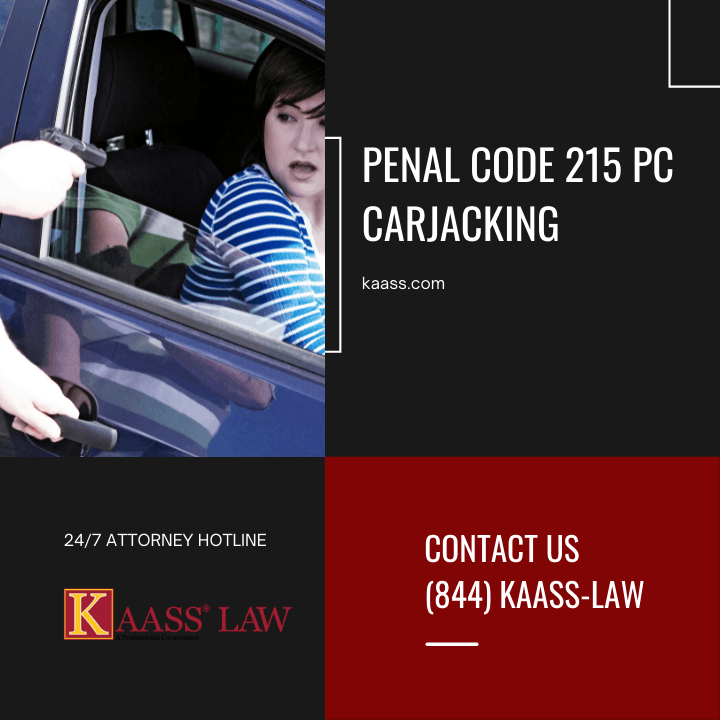
Carjacking is defined as seizing a motor vehicle from someone by force or fear, according to California Penal Code 215 PC. Using "force or fear" under this statute entails inflicting physical force or threatening to harm the victim. PC 215 can be charged if the victim is the driver or a passenger in the car, and they do not have to be the owner.
In California, carjacking is considered a felony. If you are convicted of carjacking, you might face a sentence of three, five, or nine years in state prison, and you would have to serve 85 percent of your sentence. Furthermore, under California's Three Strike Laws, carjacking is a Strike offense as a serious and violent felony, and every following felony conviction would be doubled. Carjacking is considered a crime of moral turpitude, and anyone in the United States on temporary resident status, as well as anyone with a professional license, will face urgent deportation procedures. If you are convicted of this felony, the DMV will place severe restrictions on your license.
Penalties for PC 215 carjacking conviction in California carries a:
Yes, under Health and Safety Code 11351, it is considered a felony in the state of California to possess controlled substances with the intent to sell them.
For purposes of Health and Safety Code 11351, a controlled substance is any drug or chemical whose manufacturing, possession, and use are regulated by the government under the Controlled Substances Act.
The Controlled Substance Act is a federal statute that enables the federal government to regulate the manufacturing, importation, possession, use, and distribution of certain substances. Additionally, controlled substances are placed under one of five schedules under this act. The placement is based on the following:
Construction site accidents are fairly common. An injured victim may either file an insurance claim with the at-fault party's insurance carrier and/or a personal injury lawsuit against the at-fault party.
The plaintiff must be able to prove the following elements to establish negligence in a construction accident case:
In some cases, property owners are liable for the occurred accident on their property. According to CACI 1000 in a premises liability lawsuit, the plaintiff must be able to establish the following elements:

Most people's largest purchase in their lives is a real estate property. To safeguard your interests as a buyer or seller, it is critical to ensure that the conditions of your transaction are appropriately drafted. By taking the right steps forward into such a purchase, the results will be easier to overcome. In some states, real estate closings need the presence or involvement of an attorney. Many people make the rational choice to hire a lawyer to assist them. A lawyer's purpose is to guide the sale or purchase of the property efficiently. Spending money on a real estate attorney is generally worthwhile. It is not needed in most states, however.
KAASS Law firm may be able to help you with the list provided below.
We are completely dedicated to building a case that is at our clients' greatest advantage. Furthermore, our considerable competence allows us to approach our cases with confidence, intelligence, and skill. This is the case for both in negotiations and in court. Within the legal and business areas, the firm has gained and maintained a strong reputation. We offer guidance and counseling on corporate compliance and personnel matters. We normally recommend estate plans for individual clients. This allows them to be advised on the formulation and implementation of a wide range of estate plans. This varies from the most simple to the most complex. Keep in mind, it is important to hire an attorney early on in the transaction. An attorney will be able to guide you through the process and ensure that every decision is the right decision for you. It is possible to agree to conditions that aren't in your best interests or result in an unanticipated outcome without an attorney's knowledge. It may be difficult to completely comprehend the requirements of completing a real estate transaction without such guidance. Certainly, consider your time and extra efforts. Hiring an attorney will be a great decision to successfully complete a real estate transaction. Our team, your trusted attorneys, deal with the heavy work while you are able to take it easy and watch your transaction effortlessly move forward.
Like all other accidents, we recommend taking the following steps:
Listing their drivers as “independent contractors” gives major companies like Uber a cushion to fall on. The argument is that the drivers are independent and work independently; Uber cannot be held liable for their driver’s negligence. Although this is an argument the companies can make, it isn’t always set in stone. California’s 2020 AB5 law protects app-based drivers by making it difficult for companies like Uber to deny their status as employees within that business entity. Your attorney may seek compensation from the major company as a last resort if the driver’s insurance denies coverage.
According to State law, almost all employees must receive the minimum wage. The current minimum hourly wage in California for businesses with twenty-six or more employees in 2022 is $15. For businesses with twenty-five or fewer employees, it is $14 for an hour. The required minimum wage is the employer's obligation and can’t be waived by any agreement, including collective bargaining agreements. An employer can’t use an employee’s tips as a credit toward the obligation to pay the minimum hourly wage.
According to California Labor Code Section 510, employers are required to pay their employees for overtime work after their hours. Employees who work more than 8 hours in a workday, more than 40 hours in a workweek, or more than 6 days in a workweek are entitled to overtime pay. Overtime laws don’t apply to all workers and certain workers, such as farmworkers, are covered by different overtime laws.
In California, employers aren’t obliged to provide paid time off or paid vacations to their employees. Though, the employers who choose to offer vacation should follow certain guidelines. According to California law accrued vacation is considered a form of wages that have already been earned by the employee, this means that accrued vacation can’t expire and must be paid out to an employee upon the employment termination. The same rule is applicable to paid time off.
According to California Labor Code Section, 512 non-exempt employees are entitled to rest and meal breaks. Thus, an employee must receive a thirty-minute meal break in case he works more than five hours a day. The employee is entitled to a second thirty-minute meal break if he works more than ten hours in a day.
If you quit your job and give your employer less than 72 hours' notice, your employer must pay you within 72 hours. If you give your employer at least 72 hours' notice, you must be paid immediately on your last work day. In case the employee is fired he must receive his final paycheck on his last day. In case he isn’t paid when the job ends, he may be entitled to receive an additional payment of a day’s wages for each day his employer withholds the final paycheck, for up to thirty days. If the employer ended your employment — fired you, laid you off, eliminated your position, etc. — they must have your final paycheck ready for you on your last day of work. If you ended your employment — you resigned or you quit — without notice, then the employer must have the check ready for you within 72 hours AFTER your last day of work. But if you quit AND if you gave at least 3 days advance notice to your employer of when your last day of work will be, then the employer must have your final paycheck ready for you on your last day.
Facing the challenge of an employer who refuses to pay your wages can be overwhelming and involve complex state laws. Contact KAASS LAW at (310) 943-1171 today regarding your legal rights to get immediate consultation and prompt help.
Concealing or destroying the body of the person who died would be a clear example of this offense, but there are several other ways to criminally conceal an accidental death in the eyes of the law. Hiding any piece of evidence or misleading authorities in any way would also be considered a violation of PC 152.
Concealing an accidental death is a misdemeanor offense in California. It is punishable by:
There are several ways to defend yourself if you are wrongfully charged with violating PC 152. They include:
There are circumstances in which one may hide evidence or lie to the police without actually making an attempt to conceal any death. Doing this could result in being charged with another crime, such as PC 135 (destroying or concealing evidence). However, if you didn’t actually try to hide the fact that someone died, you couldn’t be charged. Accidental deaths often create situations where people feel scared or threatened by others who know about the death. It may be the case that you want to tell authorities what happened, but others do not. If anyone who witnessed the death made a threat to you in order to keep you quiet, this is known as “duress,” and you would not be guilty of concealing an accidental death because you only did it because you feared for your own safety.
Insurers can deny a long-term disability insurance claim for a variety of reasons. For example, they might claim that your disability is not severe enough to prevent you from performing the duties of your job, or that your treatment history does not offer compelling evidence that you are too injured/ill to work. They may also reject it based on you missing a deadline that was agreed upon in the policy, so it is imperative that you are aware of when you must submit the claim in order to gain compensation. There are instances when insurers act in “bad faith” when rejecting a claim, meaning that the insurer wrongfully denied your claim or denied it based on an insufficient reason. Some examples of acting in bad faith are:
Are you in need of additional information regarding long-term disability insurance claims in California? Our employment law attorneys at KAASS Law would be happy to help you out. Get in touch with us anytime at (310) 943-1171 or fill out the form below. [contact-form][contact-field label="Name" type="name" required="true" /][contact-field label="Email" type="email" required="true" /][contact-field label="Website" type="url" /][contact-field label="Message" type="textarea" /][/contact-form]
If you cannot find the driver, compensation for the damages depends on your insurance policy coverage. Furthermore, if you have collision coverage, your insurance will cover your property damage. In addition, if you have Medpay coverage, your insurance will cover any medical bills you incur. Keep in mind, however, that Medpay will only cover the direct costs of your medical bills, and it will not compensate you for lost wages, pain, suffering, or emotional distress caused by the accident. If you have uninsured (UM) coverage, your insurance will pay for your bodily injury claim, which includes future medical expenses as well as pain and suffering. Depending on your limits, your uninsured motorist coverage will be able to provide coverage for injuries sustained by you and your passengers.
California Vehicle Code sections 20002 and 16025 make it illegal to flee the scene of an accident and withhold the required identification and insurance information from the other parties involved.
CVC 16025, requires drivers must share and exchange insurance information. A CVC 16025 offense is considered an infraction in California and is punishable by a fine of up to $250.
CVC 20002 makes it illegal to flee the scene of an accident where there is only damage to property and no injuries. It is considered a misdemeanor in California, however, it is common for these cases to be dropped, if the defendant pays financial restitution for the damages.
The penalties for violating CVC 20002 can include:
CVC 20001 makes it a crime to flee the scene of an accident where there are injuries or death. This is a felony offense in California that is punishable by:
Being the victim of a hit-and-run accident can be a frightening and frustrating experience. Here are crucial steps to take to protect your safety and legal rights:
At KAASS LAW, we are here for you. The following are some of the many things we normally offer:
Please contact us for a free consultation so may further help!
A carjacking conviction carries harsh penalties and enhancements, as well as a "strike" under California's three-strikes rule, which can be increased if the defendant:
Under Penal Code 186.22 gang enhancement a defendant can be prosecuted under this section if they either participate in a gang while furthering a felony or carry out a crime for the benefit of a gang. As such, a 15 year to life enhancement can be applied if the theft was for the benefit of a criminal street gang.
If a firearm was used during the commission of the carjacking 10 years can be added to the sentence. Although per SB620, such enhancement is left to the judge's discretion.
In the event, someone was harmed during the commission of the carjacking, three (3) to six (6) years may be added to a defendant's sentence. If a gun was discharged during the commission of the carjacking a 20-year sentence can be added.
Since every vehicle theft is a severe issue for the owner, the stakes are significantly higher when the owner is still in the vehicle when the thief acts. Carjacking is defined as the act of depriving the owner of the vehicle while they are still in or near it. However, ejecting the owner is precisely the carjacking issue. Force, the fear of force, or some other form of duress or coercion is required to eject or resist the owner. Owners do not just hand over the keys to their vehicles to criminals. Carjacking is a separate felony in part because it violates the owner's safety and autonomy, as well as the potential of significant injury or worse.
Other carjacking related crimes include:
If you or a loved one has been charged with carjacking under Penal Code 215 PC, we invite you to contact our Los Angeles criminal defense attorney today for a free consultation.
Controlled substances for purposes of Health and Safety Code 11351 include the following:
Keep in mind that possession of controlled substances such as marijuana and methamphetamine for purposes of sale are considered separate offenses not covered under Health and Safety Code 11351.
For purposes of Health and Safety Code 11351, possession is established when an individual has direct and/or immediate control over the controlled substance. Typically, this is established when the individual possesses the controlled substance if they are carrying it on them. Possession can also be established if an individual has personal control over the substance such that the controlled substance was found near or around an area that the individual exercises control over, such as in the individual’s car or garage.
Under Health and Safety Code 11351, intent to sell can be established by showing the following:
As mentioned above, violating Health and Safety Code 11351 is considered a felony. Penalties include the following:
If you or someone you know has been charged with Health and Safety Code 11351, we invite you contact KAASS LAW today at (310) 943-1171 to speak to our criminal defense attorney for a free consultation.
Under California products liability laws, whoever sells designs, or manufactures a defective product is liable for caused injuries. According to CACI 1200, the following types of defects can be involved in product defect claims involve:
A product liability lawyer near you should be able to provide you with additional information.
There are a handful of parties that can be held responsible for construction accidents, which include:
Even if the injured person is partially liable for the accident, he can still file a lawsuit against others who were also at fault. According to CACI 405 an injured victim can still recover damages regardless of his percentage of fault, however, the plaintiff’s damages award will be reduced by the proportion of negligence.
People injured at construction sites can suffer different types of injuries, including:
Under California law, a plaintiff must file a lawsuit within a two–year period from the date of sustaining a construction accident injury.
In a successful claim, the plaintiff is entitled to compensatory damages, including economic and non-economic damages.
Recoverable economic damages in a construction accident include:
Recoverable non-economic damages in a construction accident include:
In case the defendant’s acted with malice, extreme recklessness, intentional or fraud, or oppression the plaintiff can also be entitled to punitive damages.
If you or a loved one has suffered an injury in a construction accident we invite you to contact our Glendale Personal injury attorney KAASS LAW at (310) 943-1171 for a free consultation and case review.
KAASS Law's team can help you understand and plan for the tax implications of buying or selling real estate because of our extensive legal knowledge. Our lawyers will ensure a seamless transaction and provide fair solutions to any complications that arise. This may include buying, financing, selling, or leasing. Consult an experienced real estate attorney before committing significant time and money to a real estate transaction or enterprise. With whatever complexity of your transaction, KAASS Law's legal team will ensure that your rights and best interests are put forward. Give our office a call today at 310-943-1171. Ensure of a smooth transaction for your next real estate transaction. https://youtu.be/KHeVDzcvShc