
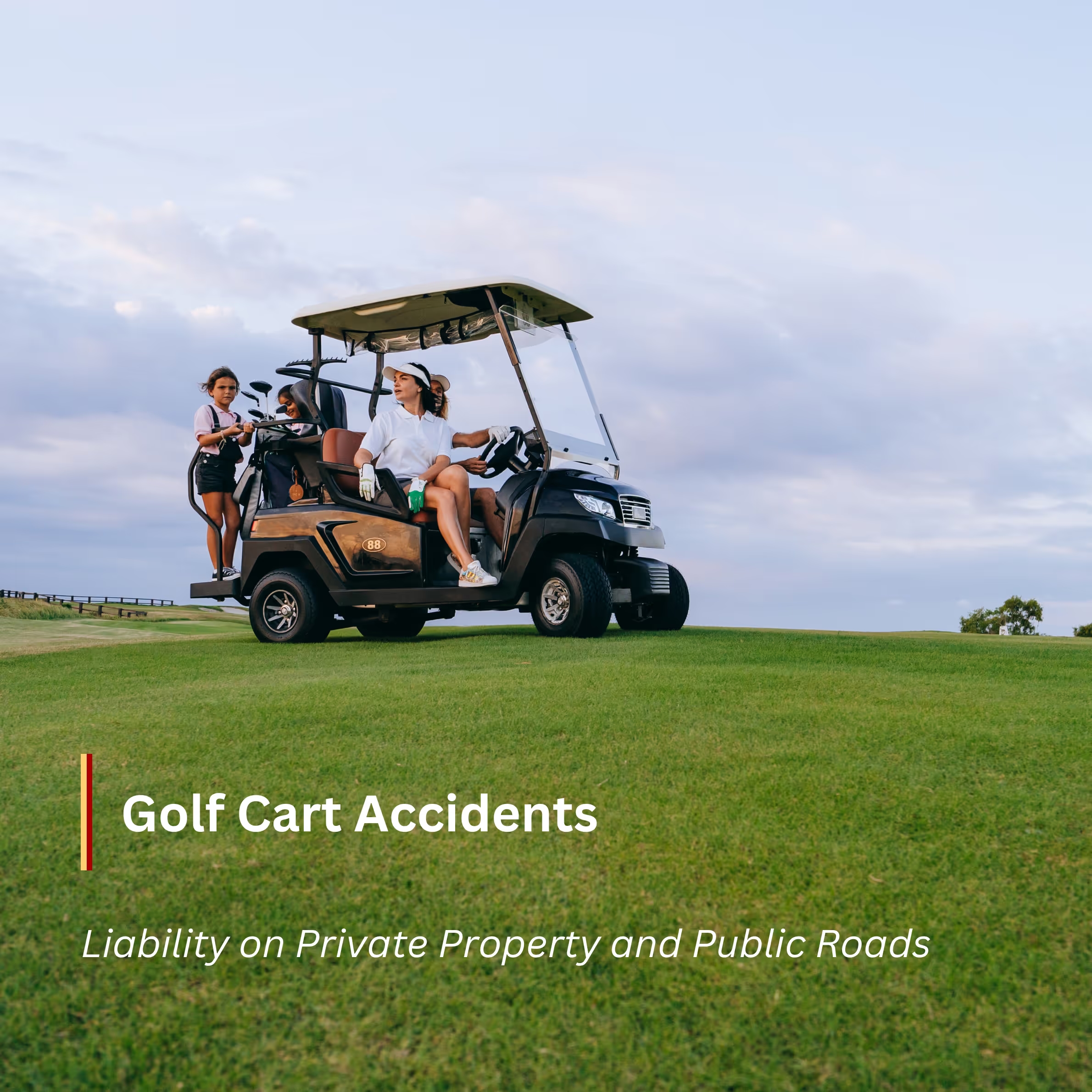
Golfing is meant to be a fun and exciting activity for many individuals and their loved ones. It is a great sport to bring friends and families together to experience joy and a sense of community. However, golf cart accidents may cause severe or sometimes life-threatening injuries when the necessary safety precautions are neglected or not put in place properly. In addition, determining who may be held responsible after a golf cart accident occurs is a difficult and challenging process to navigate by yourself. Understanding golf cart accidents and the importance of maintaining private or public properties is important the next time you or a loved one goes golfing.
Golf carts usually travel at lower speeds than passenger vehicles, but lower speed does not always mean an accident will result in minor injuries. Many traditional golf carts lack doors, airbags, and other protective features usually found in cars. Passengers may be thrown from the cart during a sudden turn, collision, or rollover. Pedestrians, bicyclists, and other road users can also be injured when struck by a golf cart.
The following are common injuries associated with golf cart accidents.
Children and older adults may face additional risks depending on the circumstances of the accident.
Many golf cart accidents occur on privately owned property, including golf courses, resorts, hotels, apartment complexes, private communities, event venues, and recreational facilities.
When an accident occurs on private property, liability may depend on how the incident happened. Property owners have the legal responsibility to maintain safe conditions for customers and other individuals. If a property was not properly maintained or included dangerous conditions, that property owner may be part of the overall investigation and possibly held accountable.
Some California communities allow certain golf carts or low-speed vehicles to operate on designated public roads. When a golf cart is legally operated on a public street, drivers may be required to follow applicable traffic laws. Running a stop sign, failing to yield, making an unsafe turn, or driving negligently could possibly result in liability if that behavior causes an accident.
Public-road golf cart collisions can also involve passenger vehicles, motorcycles, bicycles, and pedestrians. For example, if a motorist fails to yield and strikes a golf cart, the motorist may be held responsible depending on the facts and evidence of the specific case. In addition, a golf cart operator who enters an intersection improperly could potentially share responsibility.
Determining liability after a golf cart accident may be extremely difficult and require extensive evidence and documentation. A golf cart owner who allows another person to operate the vehicle may potentially face liability under certain circumstances. One issue that may arise is negligent entrustment.
Negligent entrustment typically involves providing a vehicle to someone the owner knew, or reasonably should have known, was not qualified to operate it safely. Whether negligent entrustment or another theory applies depends on the evidence and circumstances of the specific incident.
Not every golf cart accident results from driver behavior. A mechanical or product-related problem may contribute to an accident. Potential issues could include, but are not limited to, the following:
Depending on the circumstances, potential responsibility could involve a manufacturer, distributor, rental company, maintenance provider, or another entity. Preserving the golf cart after an accident may therefore be important. Repairing, modifying, or disposing of the vehicle before it can be examined could make it more difficult to determine whether a mechanical problem contributed to the incident.
Depending on where and how the golf cart was being used, potential coverage could involve a homeowners policy, automobile policy, commercial liability policy, golf course or resort insurance, rental coverage, or another form of liability insurance. However, exclusions and limitations may apply. Reviewing the relevant insurance policies can help identify potential sources of coverage.
After a golf cart accident occurs, it may be important and beneficial to seek legal guidance in order to understand your personal injury claims moving forward. A qualified personal injury attorney may explain applicable laws, speak to insurance companies, and preserve the necessary evidence and documentation needed for your specific case. This may be crucial when you have suffered injuries from a golf cart accident.
Our personal injury attorneys at KAASS LAW understand the challenges that may come after a golf cart accident. Oftentimes, determining who may be held liable can be a complicated and challenging process, and one that requires the help of a legal professional. That is where KAASS LAW comes in. If you or a loved one has suffered severe life-threatening injuries from a golf cart accident, don't wait. Call KAASS LAW today for a confidential consultation and to discuss your potential options for your case.
Walking around neighborhoods, communities, and hiking trails has always been a popular activity for many individuals and their families. This is a great way to get outside and spend time together, especially in the warmer months.
Pedestrian accidents are usually associated with negligent drivers. However, that is not always the case. Often, pedestrians may not follow the necessary safety steps to ensure they are not putting themselves in harm's way. Understanding distracted walking accidents and your legal considerations is crucial to ensuring your future safety and well-being.
Smartphones are one of the most common sources of distraction, but they are not the only one. Examples of distracted walking may include, but are not limited to, the following.
Distraction alone does not automatically make a pedestrian legally responsible for an accident. The important question is whether the pedestrian's behavior contributed to the circumstances that caused the injury.
Drivers must remain attentive to traffic conditions and watch for pedestrians, especially around crosswalks, intersections, schools, shopping areas, and other places where pedestrians are reasonably expected to be present.
Depending on the circumstances, potentially negligent driver conduct may include speeding, distracted driving, failing to yield when required, making an unsafe turn, running a traffic signal, or driving while impaired.
For example, a pedestrian may have been looking at a phone while entering a crosswalk, while the driver may also have been speeding or failing to pay attention. In this type of situation, an investigation may examine the behaviors of both individuals rather than automatically assigning all responsibility to one person.
California uses a pure comparative negligence approach to personal injury claims. This ultimately means that more than one party may be assigned a percentage of responsibility for an accident. A person's potential recovery may then be reduced according to the percentage of fault attributed to that person.
Comparative negligence is especially relevant in pedestrian cases because insurers may argue that a pedestrian failed to exercise reasonable care even when a driver's conduct also contributed to the collision.
Since responsibility may be disputed, evidence can play an important role in determining how an accident occurred and who is to be held liable for injuries. Relevant evidence may include the following.
In addition, the pedestrian's location at the time of the accident can also be significant. Whether the pedestrian was inside a marked or unmarked crosswalk, walking along a roadway, crossing outside an intersection, or entering a parking lot traffic lane may affect the liability analysis.
After a pedestrian accident, an insurance company may investigate whether the injured person was distracted. An adjuster might ask whether the pedestrian was texting, wearing headphones, looking at a GPS application, or otherwise not paying attention.
These questions can be significant because an insurance provider may argue that the pedestrian should be held responsible for some percentage of the accident. As a result, pedestrians should provide truthful information about what happened. However, it may be helpful to understand the purpose of requests for statements, authorizations, or other information before responding. Statements made shortly after an accident may later become part of a liability dispute.
Pedestrians have little physical protection when struck by a motor vehicle. As a result, pedestrian accidents may cause injuries requiring significant medical care and treatment. Possible injuries may include but are not limited to the following.
The nature and extent of injuries may vary significantly from one case to another. In addition, medical records and other documentation may be relevant when evaluating the damages associated with a claim.
Depending on the circumstances, an injured pedestrian may seek compensation and support for legal damages associated with the accident. These may include past and future medical expenses, lost income, reduced earning capacity, pain and suffering, and other losses permitted under California law.
The amount of recoverable damages often depends on factors such as liability, insurance coverage, the severity of the injuries, medical evidence, and the specific facts of the case. Comparative negligence may affect the amount ultimately recoverable if the pedestrian is found partially responsible.
It may be important to seek legal guidance and support after a pedestrian accident near or around your neighborhood. These types of accidents are more common than many people think and can result in severe or sometimes life-threatening injuries for individuals and their families. A legal professional may be able to explain applicable laws, review the specific facts of your case, and speak to insurance companies on your behalf. This may be beneficial during a difficult time such as a pedestrian accident.
Pedestrian accidents may involve multiple parties, challenging legal considerations, and various pieces of evidence. The personal injury attorneys of KAASS LAW are ready to help you understand your rights and the importance of maintaining evidence and documentation throughout your case. Our personal injury attorneys can help determine potentially liable parties, speak to insurance companies, and help you navigate the legal process moving forward. Call KAASS LAW today for a confidential consultation and to learn more about your case.