Golf Cart Accidents: Liability on Private Property and Public Roads
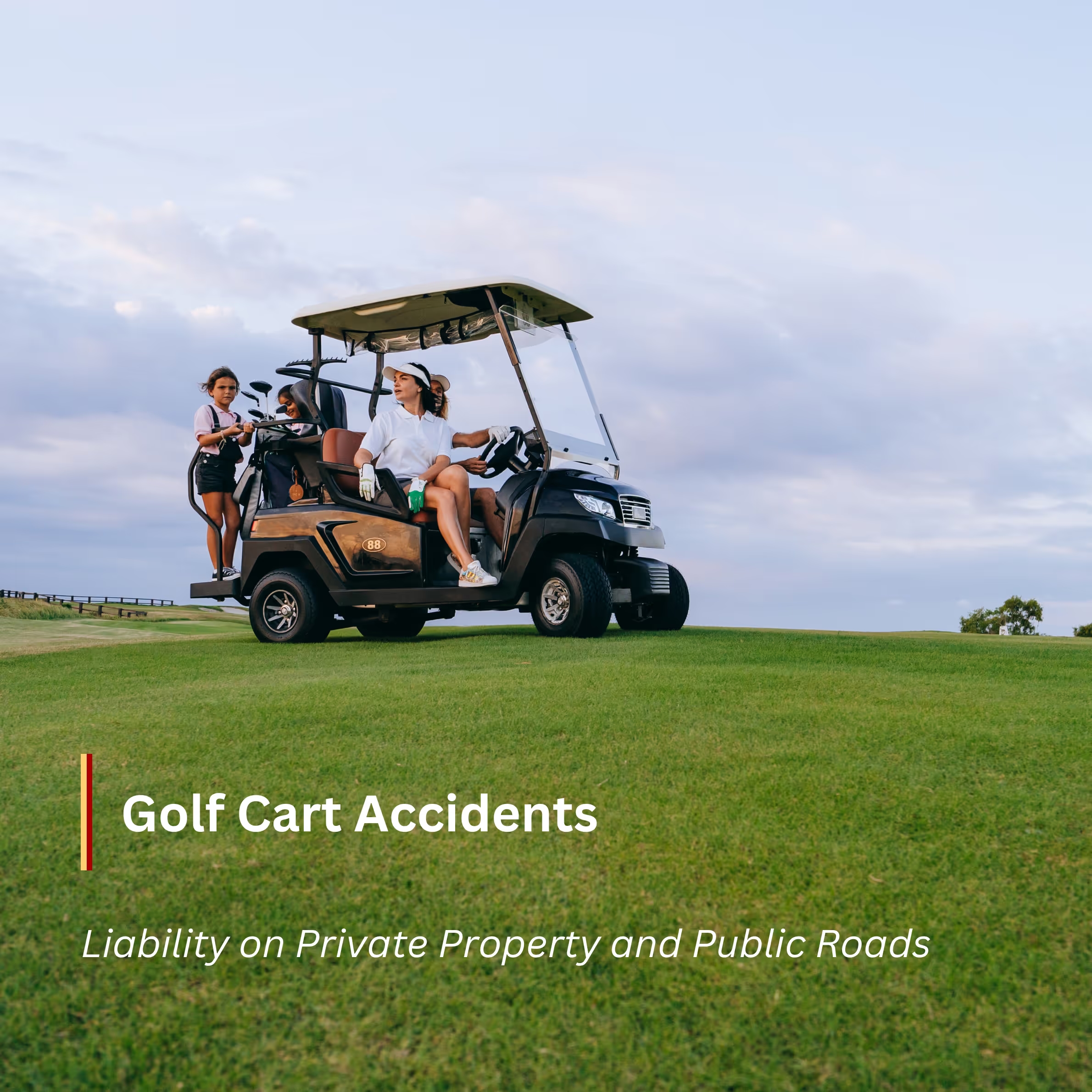
Golfing is meant to be a fun and exciting activity for many individuals and their loved ones. It is a great sport to bring friends and families together to experience joy and a sense of community. However, golf cart accidents may cause severe or sometimes life-threatening injuries when the necessary safety precautions are neglected or not put in place properly. In addition, determining who may be held responsible after a golf cart accident occurs is a difficult and challenging process to navigate by yourself. Understanding golf cart accidents and the importance of maintaining private or public properties is important the next time you or a loved one goes golfing.
Understanding Golf Cart Accidents
Golf carts usually travel at lower speeds than passenger vehicles, but lower speed does not always mean an accident will result in minor injuries. Many traditional golf carts lack doors, airbags, and other protective features usually found in cars. Passengers may be thrown from the cart during a sudden turn, collision, or rollover. Pedestrians, bicyclists, and other road users can also be injured when struck by a golf cart.
Injuries that may Follow a Golf Cart Accident
The following are common injuries associated with golf cart accidents.
- Traumatic brain injuries
- Broken or fractured bones
- Neck and back injuries
- Cuts and lacerations
- Shoulder and knee injuries
- Spinal injuries
- Soft-tissue injuries
- Internal injuries
Children and older adults may face additional risks depending on the circumstances of the accident.
Private Property
Many golf cart accidents occur on privately owned property, including golf courses, resorts, hotels, apartment complexes, private communities, event venues, and recreational facilities.
When an accident occurs on private property, liability may depend on how the incident happened. Property owners have the legal responsibility to maintain safe conditions for customers and other individuals. If a property was not properly maintained or included dangerous conditions, that property owner may be part of the overall investigation and possibly held accountable.
Public Property
Some California communities allow certain golf carts or low-speed vehicles to operate on designated public roads. When a golf cart is legally operated on a public street, drivers may be required to follow applicable traffic laws. Running a stop sign, failing to yield, making an unsafe turn, or driving negligently could possibly result in liability if that behavior causes an accident.
Public-road golf cart collisions can also involve passenger vehicles, motorcycles, bicycles, and pedestrians. For example, if a motorist fails to yield and strikes a golf cart, the motorist may be held responsible depending on the facts and evidence of the specific case. In addition, a golf cart operator who enters an intersection improperly could potentially share responsibility.
Who is Liable?
Determining liability after a golf cart accident may be extremely difficult and require extensive evidence and documentation. A golf cart owner who allows another person to operate the vehicle may potentially face liability under certain circumstances. One issue that may arise is negligent entrustment.
Negligent entrustment typically involves providing a vehicle to someone the owner knew, or reasonably should have known, was not qualified to operate it safely. Whether negligent entrustment or another theory applies depends on the evidence and circumstances of the specific incident.
Golf Carts that are Poorly Maintained
Not every golf cart accident results from driver behavior. A mechanical or product-related problem may contribute to an accident. Potential issues could include, but are not limited to, the following:
- Brake failures
- Steering defects
- Defective tires
- Battery issues
- Electrical problems
- Accelerators that malfunction
Depending on the circumstances, potential responsibility could involve a manufacturer, distributor, rental company, maintenance provider, or another entity. Preserving the golf cart after an accident may therefore be important. Repairing, modifying, or disposing of the vehicle before it can be examined could make it more difficult to determine whether a mechanical problem contributed to the incident.
Insurance Coverage
Depending on where and how the golf cart was being used, potential coverage could involve a homeowners policy, automobile policy, commercial liability policy, golf course or resort insurance, rental coverage, or another form of liability insurance. However, exclusions and limitations may apply. Reviewing the relevant insurance policies can help identify potential sources of coverage.
Seeking Legal Guidance and Support
After a golf cart accident occurs, it may be important and beneficial to seek legal guidance in order to understand your personal injury claims moving forward. A qualified personal injury attorney may explain applicable laws, speak to insurance companies, and preserve the necessary evidence and documentation needed for your specific case. This may be crucial when you have suffered injuries from a golf cart accident.
The Legal Team at KAASS LAW
Our personal injury attorneys at KAASS LAW understand the challenges that may come after a golf cart accident. Oftentimes, determining who may be held liable can be a complicated and challenging process, and one that requires the help of a legal professional. That is where KAASS LAW comes in. If you or a loved one has suffered severe life-threatening injuries from a golf cart accident, don't wait. Call KAASS LAW today for a confidential consultation and to discuss your potential options for your case.
Related Articles
View All Posts
Learn how distracted walking may affect comparative negligence, pedestrian accident liability, and potential compensation after an injury.

Child seats save lives and protect the most vulnerable passengers in motor vehicles. Young children must also ride in proper booster and safety seats for their height, weight, and age in California. However, defective car seats and boosters can cause significant injury and even death to young children.
Common Booster and Safety Seat Defects
According to state laws and regulations, all children under the age of eight must be in an appropriate car seat, with certain exceptions for older children whose parents are in the vehicle. To guarantee that tiny children are safe in the case of an accident, these standards differ based on the child's age and weight. While victims of catastrophic automobile accidents nearly always experience some injuries, the assumption is that a child safety seat, booster seat, or harness should decrease these risks and save the lives of little children. When car seat and child seat manufacturers fail to regard kid safety, the civil court system can frequently find them legally accountable.
Our Lawyers Can Represent Clients Whose Children Have Injuries
- Driver seatbacks that collapse and injure children in the back seat,
- Backless booster seats that provide no head or neck protection,
- Shield-type booster seats that allow children to hit their heads or slip out of the seat,
- Convertible child carriers that come apart,
- Insufficient designs on car seats.
Car Seat Industry Safety Standards Are Inadequate
Part of the problem with child car seat injuries stems from the absence of proper safety requirements for car seat manufacturers. There are presently no industry-wide regulations for safe performance in a kid seat in a rear-, side-, or rollover collision. Children who are too big for a child seat but too tiny to be securely secured by the vehicle's seat belt system are also in danger of harm.
What Can I Do to Avoid Purchasing an Improper Child Car Seat?
It may be upsetting when you rely on a product to keep your children safe, and that product fails. Keep up with safety recalls and unfavorable publicity for any seats or manufacturers to avoid purchasing a faulty kid car seat. The NHTSA offers a webpage dedicated to informing customers about the most recent recalls.
What Causes a Defective Child Car Seat?
The following are examples of common car seat flaws:
- A shattered foundation,
- Handles that are defective,
- Latch failures,
- Failure to properly lock and unlock buckles,
- Flammable substance.
If you're tempted to buy or give away an old car seat, resist. Child car seats have a shelf life. You will not be penalized or charged if you use an expired or used car seat. They can develop cracks and lose their straps with time, resulting in catastrophic failure in an accident. Also, do not purchase a secondhand child car seat from the internet. You don't know the seat's history, which puts your child at risk in an accident. When your children are close in age, this is an exception. You can hand it down to the younger child as long as the seat is still safe to use.
Defective Child Car Seats Can Lead to Catastrophic Injuries
Child car seats are designed to safeguard young passengers during vehicle crashes. Unfortunately, when these products are defective, such as collapsing seatbacks, faulty buckles, or poorly designed boosters, the consequences can be devastating. A lack of federal safety standards for side, rear, and rollover collisions further increases the risk. Manufacturers may be held liable if their negligence contributes to a child’s injury or death. At KAASS LAW, we’re committed to holding them accountable and protecting your family’s rights.
Get Legal Support for Child Car Seat Injury Cases
If your child was harmed due to a defective car seat, you deserve justice. Our attorneys at KAASS LAW understand the emotional and financial toll these cases can bring. We use our legal experience and investigative resources to pursue maximum compensation for families affected by design flaws or manufacturing failures. Let us help you hold negligent companies responsible. Call us at 310-943-1171 or explore more of our legal services online.
Fighting for Defective Child Car Seat Victims
Children who survive a vehicle accident with a faulty safety seat may miss out on a lifetime of chances ranging from lifelong paralysis to traumatic brain damage to spinal cord injuries - and regrettably, many of the tiniest children cannot survive such a crash at all. Our experienced personal injury attorneys at KAASS LAW have considerable investigative tools to assist you in exploring all legal options following a tragic death or catastrophic injury. You can contact us at 310-943-1171. We believe in finding justice for families and ensuring that no parent has to endure the same pain because we've seen firsthand the devastation that vehicle faults can bring. You can rely on our team to offer the compassionate representation you need following a vehicle accident. Visit this link to be introduced to our additional practices.

Spinal cord injuries commonly occur after a slip-and-fall accident. When you've fallen and hurt yourself, it may seem like your rehabilitation process will take months. Some people may experience back discomfort that persists after slipping or falling, which can cause sadness to set in very fast. Spinal cord injuries brought on by falls have significantly increased during the previous 40 years. Environmental factors like icy surfaces or wet floors frequently cause same-level slip-and-fall accidents. Serious spinal cord damage can ensue from such incidents, especially in the elderly population. Slips and falls often result in more serious, life-threatening consequences for older individuals. Additionally, their hospital stay is longer, and their medical expenses are higher.
Injury to the Spinal Cord
One of the most severe and disabling injuries brought on by a slip and fall is a spinal cord injury. A broken or displaced vertebra may be the cause of a spinal cord injury. There are two types of spinal cord injuries: complete and incomplete. When the cord can no longer convey impulses below the level of injury, it is considered complete. As a result, the area that has been under the impact is losing all sensation below. If the injury is not complete, the victim can still move somewhat and feel a little under the stress.
Can Spinal Cord Injuries Get Worse Over Time?
The fact that slip and fall accidents have both short-term and long-term effects is a very common concern. You are significantly more likely to have a major injury following a fall if you are a high-risk person, such as an elderly person or someone with brittle bones, previous damage, or fissures. Torn ligaments, crushed discs, and pinched nerves can also result in severe harm that may last a lifetime. The spine has three primary regions:
- the neck's cervical vertebrae (upper spine)
- the middle back's thoracic vertebrae
- the lower back's lumbar vertebrae
Different regions of the body are affected by the discs, nerves, and muscles that are unique to each region of the spine. Chronic pain can quickly deteriorate due to improper diagnosis or lack of therapy, leaving you in moderate to severe discomfort.
What Do I Do if I Get a Spinal Cord Injury?
Every patient is different, thus we always create individualized treatment strategies for each of them. However, there are some commonalities among those who slip and fall that can help us identify issues and develop better solutions for quicker relief. Recognizing the causes of your back injury symptoms may be made easier if you are aware of these conditions. Always get a medical professional's advice before attempting any remedies. Early treatment can lessen the intensity of your pain and stop permanent nerve and muscle damage.
Vertebral Compression Fractures (VCFs)
Vertebral compression fractures (VCFs), which can occur anywhere in the spine but are most frequently found in the lower thoracic and upper lumbar spine, can be caused by some falls. From excruciating pain to physical deformity, the impacts are varied. People with brittle bones are more likely to get VCF injuries, just like patients with osteoporosis. Compression fractures are also more likely to occur in postmenopausal women. Vertebral compression fracture symptoms include:
- abrupt backache
- discomfort when standing or sitting
- less discomfort when lying on your back
- decreased mobility
- loss of height, incapacity, or progressive deformity
- slipped discs
The softer inner component of the disk might herniate when a disc ruptures due to a fall or slip that twists the spine. This puts pressure on the nearby nerves, which can cause mild to severe pain, tingling and numbness, and weakness of the muscles. Herniated disc sufferers can experience discomfort that corresponds to individual spine injuries. For instance, you might feel discomfort and tingling in your lower limbs if a disc in your lumbar region herniated. Herniated discs can be controlled early on with chiropractic care, physical therapy, therapeutic ultrasounds, steroid injections, and medication, but surgery is the only effective treatment for them.
Contact Slip and Fall Injury Attorney Today
One of our many practices is slip and fall accidents. If you sustain a spinal cord injury from slip and fall accident, contact Kaass Law experienced an attorney for a consultation and case evaluation. With our help, you can file a California slip and fall claim and seek the financial compensation you deserve. Feel free to give us a call at 310.943.1171