When a gym member experiences an injury at a gym or a fitness center as a result of an unreasonably dangerous condition or some other negligence, he may be able to sue the gym for caused injuries and recover money damages suffered from the gym related injury.
Before filing a personal injury lawsuit several important issues must be considered:
The type of injury the victim has suffered;
Whether or not the gym membership contract contained a release of liability waiver; and
Whether the negligent actions of gym owners and staff led to the damages.
In California Can a Gym Be Held Liable for Injury Suffered by its Member or Patrons?
Gym can be liable if the injury is proven to be causes by the facility’s fault. This can be due to construction hazards, faulty equipment, or improper maintenance procedures. The gym has a certain degree of responsibility to ensure the members well being.
Some specific situations or examples when an injured person may sue the gym and seek compensation include:
Uneven, wet, or broken floors that are not signed properly;
Improperly maintained equipment;
Poor advice from a trainer or other gym staff member how to use the equipment;
Dangerous objects that are stored not properly.
Common Injuries Suffered in a Gym or Fitness Center
Some of the common injuries that gym accidents can cause:
Fractured Bones;
Neck and spinal injuries;
Internal bleeding;
Sprains and Strains;
Spinal Cord Damage;
Brain Injury;
Facial injuries;
Eye Injuries;
Crush Injuries;
Traumatic Head Injury; and
Nervous system damage
A Gym or Fitness Facility Must Use Reasonable Care to Discover Any Unsafe Conditions
Gym owners must use reasonable care to discover any unsafe conditions; they are also responsible for fixing dangerous conditions and warn the gym members about those dangers. In case a property owner is unable to fix the dangerous condition he must put up a notice or warning of the hazard. A person injured in fitness center may be able to recover damages for medical bills, hospital bills, physical or occupational therapy, medical supplies, lost wages, pain and suffering, lost earning capacity, punitive damages and property damage.
Legal Defenses to Gym Accidents Involving Members or Patrons
The more popular legal defenses that fitness facilities such as LA Fitness or 24 Hour Fitness may use to defend gym accident lawsuits include the following defenses.
Assumption of Risk Defense in Gym Accidents
Assumption of risk is a legal defense that makes liable a person who engaged in strenuous physical activity. The gym owners can prove that the victim assumed the risk of injury, knew he could get hurt at the gym and chose to join anyway.
Gym Release of Liability Waivers
Generally, most gyms and fitness facilities require their members to sign a waiver of liability. While, others gyms or fitness centers may post disclaimers that all members are working out at their own risk.
Moreover, gyms generally include a release of liability waiver within their membership contract which depending on the language ultimately releases the gym and its employees from liability in the event the member suffers an injury and wants to file a personal injury lawsuit against the gym. However, a gym and fitness facility can not completely reveal themselves from absolute liability. The skilled Glendale personal injury attorney at KAASS LAW have been able to successfully sue and recover money damages for injuries suffered at a fitness facility with the existence of release of liability waiver.
Suing a Gym in California For Suffering Injury
In California a victim can sue a fitness center or a gym in California for suffering an injury due to::
He was purposely injured by someone at the gym,
The gym didn’t repair defective or broken equipment and allowed to work out on it,
It was grossly negligent.
As such, a release of liability gym waiver can be considered void if it is overly broad or violates public policy.
Gym Accidents Defective Exercise Equipment
In some cases gym accidents are caused by a defective piece of exercise equipment. A part of workout equipment can break and cause a person to lose control of the equipment and suffer an injury.
Product Liability in California for Defective Exercise Equipment
According to California's products liability law, the company who manufactured, designed, or sold the defective workout/fitness equipment product is liable for caused injuries. The injured person does not have to prove the company was negligent. In product defect cases, strict liability can be imposed for manufacturing defects, design defects, and failure-to-warn defects.
Los Angeles Gym Accidents Lawyer
Have you been injured due to a gym accident in California? If so, we invite you to hire our dedicated Los Angeles gym accident lawyers today. You can rely on our experienced lawyer to carefully analyze the facts of your case to prove the facts necessary.
California Penal Code Sections 451 and 452 address the crime of arson. It is illegal to willfully, maliciously or recklessly burn a property, forest, a piece of land or a structure, or to assist another in committing the same act. A person can also be charged with arson if he set fire at own property in an attempt to commit insurance fraud.
California Penal Code 451 Malicious Arson
The prosecutor must prove the following element to charge a person under California Penal Code Section 451 “malicious arson”
Defendant set fire to or burned a property, forest, a piece of land or a structure ( it is not necessary to destroy or damage the entire object, damaging even a small part is enough)
Defendant did so maliciously and willfully
California Penal Code 452 Reckless Arson
The prosecutor must prove the following element to charge a person under California Penal Code Section 451 “reckless arson”
Defendant set fire to or burned a property, forest, a piece of land or a structure
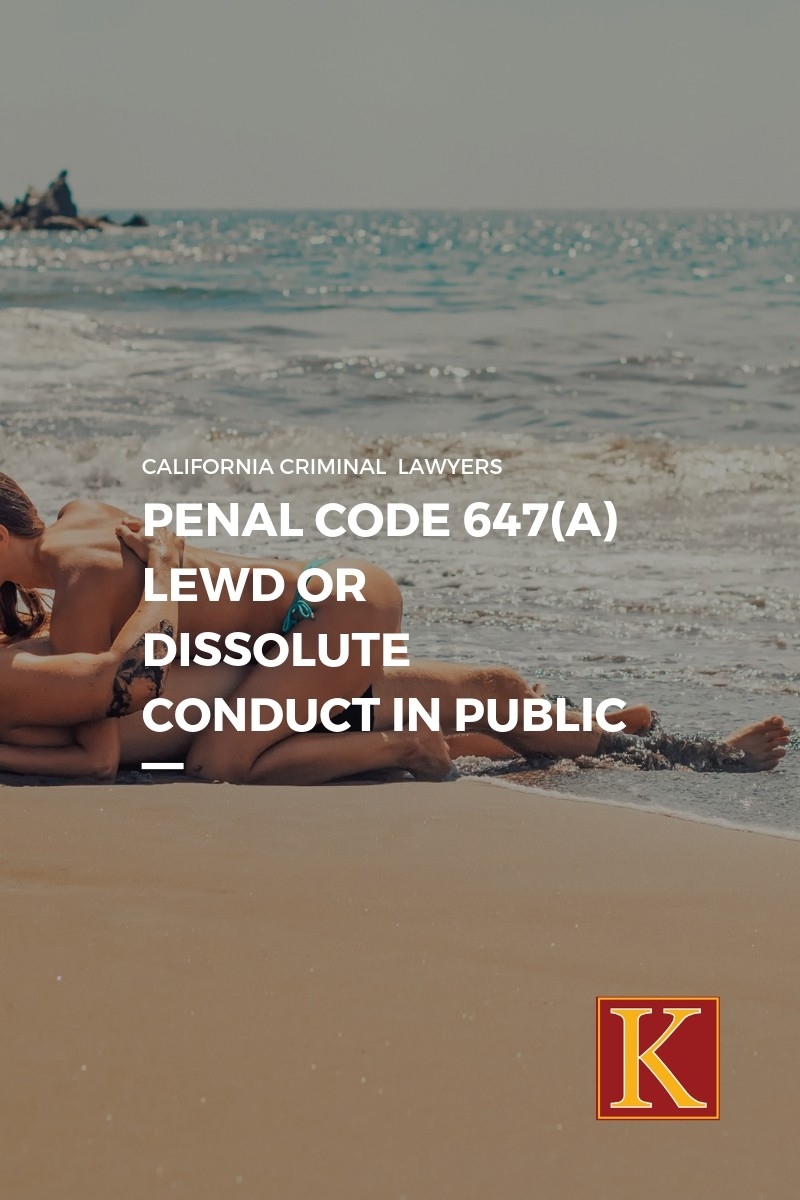
According California Penal Code Section 647(a) it is prohibited to engage or solicit another person to engage in lewd or dissolute conduct in any public place or in a place open to the public or exposed to the public view.
What Needs to Be Proved to be Found Guilty of Penal Code Section 647(a)?
To prove that the defendant is guilty of engaging in lewd conduct, a prosecutor must prove following elements:
Defendant intentionally engaged or solicited another person to engage in lewd or dissolute conduct (touching of own or another person's genitals, buttocks, or a female breast)
Defendant did so with the intent sexually to arouse or gratify himself or another person or to annoy or offend another person;
Defendant engaged in the conduct, in a public place or was in a place open to public view
When defendant was engaged in the conduct, someone else who might have been offended was present
Defendant knew or reasonably should have known that another person who might have been offended by his unlawful conduct was present.
HOAs otherwise known as Homeowners Association, will have its own HOA bylaws, rules and regulations, as outline in its Declaration of Covenants, Conditions, and Restrictions, or CC&Rs for short.
The CC&Rs act as the governing documents by which the HOA conducts its business, which is usually to ensure that the properties within the planned community have as high of a market value as possible. However, there are also bylaws to beware of, as there are some key differences between the HOA bylaws and the CC&Rs.
What is a CC&R?
To be clear, the CC&Rs serve as the legal binding document that outlines the guidelines for the planned community, as well as how all of the members within that community should conduct themselves.
CC&Rs are recorded and archived within the county records of whichever county the property is located. Basically, that’s all a really fancy way of saying that the CC&Rs are legally binding and getting out of it is extremely difficult since it gets recorded and reported to county officials. It also goes without saying that upon purchasing a home within a planned community, you automatically become a member of the homeowners’ association there, whether you like it or not.
California CC&Rs Restrictions and Laws
Put simply, the CC&Rs are the rules of your community. Those can include many differences protocols, regulations, and some of them can be very oddly specific (link here to the previous article).
One of the most frequently-charged drug crimes is possession of a controlled substance, under California Health and Safety Code 11350 Possession of a Controlled Substance. It is prohibited possessing certain controlled substances without a valid prescription. Controlled substance is a chemical or a drug whose possession, manufacture, and use are regulated by the United States "Controlled Substances Act".
Unlike Health and safety code 11365 which governs unlawful use of controlled substance, In order to being convicted of Health and Safety Code Section 11350 Possession of a Controlled Substance, the following elements must be established:
Defendant illegally possessed a controlled substance
Defendant was aware of its presence
Defendant was aware of the substance’s nature or character as a controlled substance
The controlled substance was in a usable amount.
What is Considered a "Controlled Substance" in California?
The rise of the app-based sharing economy has led to many insurance challenges. States like California have taken steps to protect consumers. From homesharing to ridesharing, the U.S. population is embracing the sharing economy. People frequently rent cars through platforms like Turo or use ridesharing services such as Uber and Lyft.
California Public Utilities Commission Regulating Ridesharing
California was the first state to regulate ridesharing services. It requires companies to obtain a license from the California Public Utilities Commission, provide a minimum of $1 million in insurance, conduct vehicle inspections, and offer driver training programs.
Liability Issues with Rental Sharing Economy Apps
When an accident occurs involving a vehicle rented through an app like Turo, liability issues may arise. California's AB 1871 bill specifically addresses liability for car-sharing. Under this law, Turo is considered the vehicle owner during the rental period. The law also prevents your insurance company from canceling your policy due to participation in car sharing.
Is Turo Liable for Insurance Purposes During the Rental Period?
The catch with purchasing a home or a condo in a co-op, planned unit development (PUD), or common interest development (CID) in California, is that you also automatically become a member of a homeowners’ association (HOA) club. The club, while exclusive, is not necessarily the kind of club you would want to be a part of just for the name or the bragging rights. This is because with your membership to an HOA, you automatically give up a lot of control over your own property. Clearly, if you are in the market to spend a lot of money on a new property, you probably want as many freedoms with it as you would expect, therefore, it is crucial you understand the ways that being a member of an HOA can limit those freedoms.
Who are The Board Members of Homeowners’ Association in California?
A homeowners’ association is comprised of members who own property within the subdivision. Most HOAs are operated by a board of directors, usually made up of a small group of volunteer homeowners.
CC&R Rules, Regulations, and Covenants
All members of the HOA must agree to abide by certain rules and regulations which are outlined in the covenants, conditions, and restrictions (CC&Rs) section of the agreement.
California Penal Code Section 550(a) covers and defines healthcare fraud, which sometimes is also referred to as health insurance fraud and medical billing fraud. Healthcare fraud is submission of false claims or disinformation of healthcare insurers about care or services that may or may not have been provided. Penal Code Section 550(a) lists a range of unlawful conduct and here are some examples that could lead to California health care fraud charges:
Presenting fraudulent or false claim for the payment of an injury or loss
Presenting several claims for the same injury or loss
Participating in a vehicular collision or any other accident, for the purpose of presenting fraudulent or false claim.
Presenting a fraudulent or false claim for the payments of a loss for destruction, damage, theft
Causing a fraudulent or false claim for payment of a health care benefit.
What is Required to Convict a Person of Healthcare Fraud Penal Code 550(a)?
Under California Penal Code 186.10 money laundering is a financial crime referring to transactions intended to promote or facilitate criminal activities, or transactions knowingly made with proceeds from criminal activity.
To prove money laundering under Penal Code 186.10 the prosecutor must prove the following elements:
Defendant conducted or attempted to conduct a financial transactions or a series of transactions through a financial institution.
The total sum of transactions was more than $5,000 in a seven day period or more than $25,000 in a 30 day period.
Defendant made the transaction with intent to promote criminal activity or he knew that the money involved were from the proceeds of criminal activity.
What Qualify as "Transactions" in Money Laundering Cases?
Money laundering is the act of using stolen funds to conduct a transaction through a bank or some other financial institution. California law lists the types of activities which can qualify as transactions, those are: withdrawals, bank deposits, wire transfers, fund transfers, payments, and other financial activities. Attempts to conduct business can also qualify as money laundering even if the transaction isn’t finished. In case the funds are used for making purchase or for any other reason, they won’t be considered to have been laundered under California law.
California civil litigation proceedings help resolve private conflicts between people, businesses, and/or the government in Government Tort Claims actions. Litigation is one of the most fundamental aspects of law. It refers to the formal process of resolving legal disputes by filing or responding to complaints through the public court system.
Litigation Lawyers and Legal Processes
What most people tend to think of when they think about lawyers and courts is typically not very representative of what actually goes on. The classic Law and Order portrayal of law in Hollywood, albeit very immersive and dramatic, does not give a realistic overview of what the legal process entails, or how one goes about it.
California Litigation Process
A much more reasoned approach to understanding how the legal process works, would be to simply take a look at the process of taking legal action, or litigation. In any case, the process begins when someone files suit. Typically, the plaintiff begins this process when they file a formal complaint with the clerk of the court. At this point, the defendant must be notified that a lawsuit was filed against them, so as to give them the proper notice before a court date. The defendant must then figure out their strategy to deal with the lawsuit and so usually a lawyer or firm gets hired on to help with legal counsel and representation. Then, the court establishes personal jurisdiction and a location is finalized for the court that will have authority over the complaint.
The term “structure” includes not only inhabited or uninhabitable residence but also tunnels, bridges, tents and power. The term “property” includes any personal property of another person like furniture, vehicle, clothing etc.
Penal Code 452 Describes “Recklessly”
Defendant was conscious that his actions present a significant and unjustifiable risk of causing a fire
Defendant ignored that risk
Doing so was a gross departure from what a reasonable person would have done in a similar situation
Legal Defenses to California Penal Code 451 or 452 Arson Charges
The fire was an accident
If a person can prove that the fire started accidentally, was absolutely an unintended and went out of control, he won’t be considered guilty of these crimes. There are situation when a person unintentionally created high risk of a fire, but was unaware of the risk because was impaired or voluntarily intoxicated (was drunk or on drugs as a result of his own actions). Though the person was incapable of understanding or appreciating the risk that will not serve as a defense to California Penal Code Section reckless burning charge.
Lack of Sufficient Evidence
Most arson cases are built with only on circumstantial evidence, with no witnesses. The physical evidence does not show the person started a fire, this make the prosecutor’s case very difficult to prove.
The fire was not the reason of arson
Before a person can be convicted of arson, the prosecution needs to prove that arson even took place. Arson is a crime which requires very sophisticated technical investigation.
Penalties for California Arson Conviction
Penalties for California arson charges vary a great deal, depending on: the nature of the burned property, the defendant's criminal history and whether someone was injured as a result of the fire.
Penalties for Penal Code 451 Malicious Arson Conviction
Under PC 451 malicious arson is always a felony, punishable by imprisonment in the California state prison. The potential prison terms are:
Sixteen months, two three years for malicious arson of personal property;
Two, four or six years for malicious arson of forest or a structure;
Three, five or eight years for malicious arson if an inhabited building was burned
Five, seven or nine years if the arson caused great bodily injury to the victim
Fine of up to $10,000 to all types of malicious arson
The defendant can face an additional fine up to $50,000 or twice the amount of expected financial gain from the fire.
Is it illegal to Engage in Sexual Activity in Public in California?
In California it is not illegal to engage in a sexual activity in public. It's only considered unlawful in case person knew or reasonably should have known of the presence of another one who was likely to be offended.
What is Considered as "Public" in Lewd Conduct Penal Code 647(a) Cases?
The term “public” is broadly interpreted in lewd conduct cases. It can be a place open to the public such as a vehicle parked by the road, a hallway in an apartment building, shopping malls, adult book stores, public bathrooms. Locations like home, hotel room, place of business are not considered public places. But there can still be a violation of Penal Code 647(a) in case a person can be seen through an open window or door with no blinds or curtains.
What are Legal Defenses to California Penal Code 647(a)?
Defendant didn't do anything lewd or dissolute
In case the defendant did not touch himself or another person in a way that can be considered as lewd or dissolute act then he is not considered guilty. The prosecutor has the burden of prove that the defendant was engaged in lewd conduct.
Defendant had a reasonable belief that no one was present
This crime requires that person intentionally expose himself in a public place where other people were in plain view or in an area where people usually gather. Unless defendant knew that someone would likely see him and be offended, he won’t be considered guilty Under Penal Code 647(a).
Conduct Was Not In A Public Place
In case the sexual activity took place on private property or an area where the public is not invited then it is not considered a lewd conduct.
Penalties for Lewd or Dissolute Conduct in Public Under Penal Code 647(a)
Under California PC Section 647(a) engaging in or soliciting another to engage in lewd conduct is a misdemeanor offense, and the penalties are the following:
Up to six months imprisonment in county jail and/or
Fine of up to $1,000.
However, judges usually place first time offenders on probation with little or no jail time. A misdemeanor conviction carries an informal or summary probation for three years. A conviction for lewd conduct in public does not require defendant to register as a sex offender.
Penal Code 647(a)Defense Lawyer
For answers to any other questions you may still have about California Penal Code 647(a) or to discuss your case confidentially with our team of experienced California criminal defense attorneys, give us a call at (310) 943-1171. Our lawyers in Glendale, Los Angeles County, CA, are highly dedicated to serving the needs of our clients.
For example, the CC&Rs may say that you need to keep your garage door shut or they might forbid you from painting your house a certain color. Basically, the CC&Rs tell you what you can and cannot do with your property because it is in a planned community.
Other things that CC&Rs frequently regulate include:
Basketball hoops
Fences or hedges
Garbage cans or disposals
TV antennas/satellite dishes
Clotheslines
Where you can park
And much, much more…
California Homeowner's Association Penalty Fees
As you can see, there are lots of things to watch out for in a CC&Rs since they can be so particular about what is and is not allowed. If you don’t heed the rules set forth by the CC&Rs, then the homeowners’ association can fine you penalty fees and potentially even force you to give up the house for frequent violations.
By The Way... Bylaws are Different
So, now that we have gone over what CC&Rs are... It’s time to tackle the other elephant in the room: HOA Bylaws. To do that, we have to first understand what an HOA is and how it is set up. A homeowners’ association is almost always established as a nonprofit corporation so that they can spearhead and manage private, planned communities.
Just as with other corporations, an HOA must be governed by a board of directors whom the members elect and a set of rules called bylaws must be written into effect.
What are HOA Bylaws?
The bylaws state how the HOA conducts its operations and business and they contain all of the information and details necessary to run the HOA as a business. Therefore, just like other businesses and corporations, HOA bylaws discuss matters like:
When, where, and how often the HOA holds its meetings
How the meetings are organized and carried out
The duties and responsibilities of the offices of the board of directors
How many people and positions are available on the board
Members’ voting rights and how votes are conducted
As you can see, the HOA is filled with bureaucracy and much of its internal processes are very boring and time consuming. Of course, because it needs to be run by the people who are its members, that means that your neighbors within the planned community are all going to be present at these proceedings and meetings.
This can amount to quite a lot of neighborhood drama if people disagree upon which rules or laws to set or remove from the bylaws or CC&Rs. Therefore, as a minimum level of precaution we warn and strongly advise all of our clients who are considering purchasing a home in an HOA community to take some time and to familiarize themselves with both the CC&Rs as well as the bylaws of the HOA so that you can be aware of any neighborhood restrictions and prohibitions.
California HOA Lawyer
Contact our California homeowner association lawyer if you have a dispute with your HOA, HOA insurance claims, HOA penalty, adverse action taken against you by HOA for failing to follow California Homeowners’ Associations and CC&Rs, or any other HOA related matter.
We break down the details to you very clearly so you do not fall into a costly trap later and we can also help you fight some of the ridiculously restrictive rules and regulations of some CC&Rs. If you have any questions or concerns surrounding homeowners’ associations and the covenants, conditions and restrictions that they may come with, we highly encourage you to give us a toll free call at (310) 943-1171 to speak to our California homeowner association lawyers today.
According to California Health and Safety Code a "controlled substance" can include a wide range of drugs, including, but not limited to stimulants, hallucinogens, depressants, opiates, cocaine, heroin, methamphetamine, PCP.
Three Types of Controlled Substance Possession in California
There are three types of controlled substance possession: actual possession, constructive possession and joint possession. Actual possession of a controlled substance means having drugs on person with immediate or direct physical control over it. Constructive possession means not having drugs on person but having the authority to control the possession of drugs. This means that the defendant does not need to be caught with drugs in his direct possession in order to be charged under HS 11350(a). Having joint possession means sharing actual or constructive possession with at least one other person.
What Are the Legal Defenses for H&S Code 11350
Defendant Held a Valid Prescription
The defendant is excused from violation of Health and Safety Code 11350 as long as he held valid prescription for the drug and the possession was consistent with the purpose of the prescription. A legal written prescription is given form physician, dentist, podiatrist, or veterinarian licensed to practice in state. This defense won’t apply if the defendant possessed a fraudulent prescription for the drug or was found in possession of more drugs than was prescribed.
Defendant Had Temporary Possession of the Controlled Substance
Temporary possession will serve as a legal defense in case the defendant possessed the drugs with the aim to dispose or destroy them for terminating its unlawful possession. This defense won’t absolve the defendant from criminal culpability in case he exercise control over the drug but willingly dispose it.
Defendant Didn’t Possess the Controlled Substance Defense
Health & Safety Code section 11350 specifically punishes for the possession of something illegal. Therefore, in case the defendant did not actually or constructively possess the controlled substance then he can't be committed in violation under the essence of this law.
Lack of Knowledge Defense
According to Health & Safety Code section 11350 the defendant must be aware of the presence of controlled substance and knew its nature or character as a controlled substance. Therefore, knowledge is an essential part of this crime. In case the defendant wasn’t aware that the possessed drugs were illegal, he must be acquitted of illegal possession
Penalties for Health and Safety Code 11350 Conviction
Possession of controlled substances under Health and Safety Code 11350 is misdemeanor. Penalties for conviction are the following:
Up to one in county jail, and/or
Fine of up to one thousand dollars
If the defendant has prior convictions for especially serious felonies, gross vehicular manslaughter while intoxicated, sex crimes against a child under 14, or sexually violent offenses he will face felony penalties such as sixteen months, two or three 3years in prison. Additionally, in case the defendant is not a citizen of the United States, a conviction for possession of illegal drugs can lead to deportation, denial of reentry and denial of naturalization.
H&S 11350 Defense Lawyer
For answers to any other questions you may still have about California Health and Safety Code 11350, about being present while controlled substances are used, or to discuss your case confidentially with our team of experienced California criminal defense attorneys, give us a call at (310) 943-1171. Our lawyers in Glendale, Los Angeles County, CA, are highly dedicated to serving the needs of our clients.
The AB 1871 bill makes Turo liable for insurance instead of your personal coverage. Once the $1M insurance limit is exceeded, Turo becomes responsible. Turo must also indemnify you in any civil action, replacing your personal insurance unless the incident results from willful negligence. Turo’s Third-Party Automobile Liability Insurance includes property damage claims and Uninsured/Underinsured Motorist (UIM/UM) coverage.
California Turo Car Rental Accident Lawyer
If you’re involved in a peer-to-peer car rental accident in California, contact our experienced Turo car rental accident lawyer. Our attorneys have extensive experience securing significant settlements from insurance companies known for denying claims. We’ll thoroughly review your case to gather the necessary evidence. To schedule a free consultation, call KAASS LAW at (310) 943-1171 or contact us via our online appointment form.
These CC&Rs limit the freedoms of individual homeowners’ by putting executive and decision-making rights into the clutches of the homeowners’ association at large. In doing this, the agreement serves as a legally binding document that allows others within the community to make decisions about what you can and cannot do with your property on your behalf.
How Bad Can Homeowners Associations Really Be?
Okay, so far, the whole things sounds awful, right? Well, the thing is there is not really much good that comes out of homeowners’ associations for most people: some associations fancy themselves neighborhood officers and enforce every rule with the same zeal that a cop might have for giving someone a ticket on their morning commute to work, whereas others are far more chilled out and do not really bother to interfere with their members’ lives.
Homeowners Association Regulations on Planned Unit Development Community
As a general rule of thumb, most homeowners’ associations will always want to make decisions that serve to improve the value of the houses in the community. While that may sound like a very noble intention, it often means that the association gets the ability to dictate very constrictive regulations on the entire community living there.
Are CC&R's Legally Binding?
Since these agreements and their CC&Rs that come with them are legally binding, you will absolutely want to be sure that you have read up on the details of the agreement. Otherwise, you might end up purchasing a property where the CC&Rs are incompatible with your lifestyle. For instance, many CC&Rs outright prohibit you from painting your house certain colors, specify which colors of curtains or blind are acceptable if they are visible from the street, and even detail what kinds of front yard landscaping or pruning you can do. Honestly, there is virtually no limit to how weirdly specific the rules in CC&Rs in an HOA can get. Some common examples that they can restrict or regulate include:
Shingles and exterior paint color
Trees, lawns, and weeds
Adding or modifying rooms in your house
Swimming pools and jacuzzi construction
Fences and hedges
Garages and sheds
Outdoor lights and satellite dishes
Pets (size and breed)
Noises and obstructions
Windows and wreaths
Bathroom Remodeling
As such, it is always in your best interest to read your the provisions outlined in your CC&R's thoroughly and carefully.
Getting Out of HOA and CC&Rs **Fees Apply
Another negative aspect of homeowners’ associations is that once you own property within the community, getting any help or relief from overbearing restrictive CC&Rs is extremely difficult. Most likely, you will have to submit a detailed application with a hefty fee for a variance, ask for your neighbors’ express permissions, and maybe even attend formal hearings and proceedings to see what is decided about your case. The bureaucratic processes only worsen if you want to make any structural changes to your house, like adding a room or building a fence. In those cases, you will most likely have to receive formal permission from the association, in addition to complying with city zoning laws.
Homeowners’ Association Common Property or Common Property Areas
The last straw for most prospective buyers is the fact that homeowners’ associations almost always require members to pay fees on a monthly basis, which can feel an awful lot like paying for rent on top of your mortgage.
What are HOA Fees Used For?
These fees are to cover costs for ‘common property’ maintenance such as pools, golf courses, gardens, walkways, and other facilities. Sometimes, the fees can run as high as hundreds of extra dollars a month. Worse still, lots of homeowners’ associations give their boards permission to raise the costs by up to 20% per year as well as imposing new taxes and fees into the final cost without even requiring a membership vote.
Liability of an HOA Board Member
When a HOA fails to maintain that common areas, misuses HOA funds, the HOA may be in breach of their fiduciary duties of HOA Board Members. An HOA board member is typically only personally liable in these lawsuits if the member breached his or her fiduciary duty to the HOA. Often times in HOA can find themselves liable during homeowners insurance claim disputes amongst neighbors which generally result in a lengthy litigation battle.
The Bottom Line–Our Two Cents on Homeowners Association
If you are worried about any of the restrictions we mentioned earlier, or if you have concerns that homeowners’ association fees may get out of hand, you should definitely refrain from purchasing a property that requires you to become a member of an HOA. Make sure you do your research thoroughly about the exact terms and conditions that the property entails, because most times the sales agents for units within a community will not ever warn you of these restrictions. They do a great job of selling you the property–and a poor job of telling you about the baggage and the bureaucracy the property comes with.
California Homeowner Association Lawyers
At KAASS LAW, our California homeowner association lawyers believe that your home is a sacred place and running into problems with your HOA and insurance claims can be a frightening and overwhelming experience. Making the move to own instead of renting is a huge stride toward future financial success for anyone, and we want that process to be as rewarding and stress-free as it can be for our clients. We break down the details to you very clearly so you do not fall into a costly trap later and we can also help you fight some of the ridiculously restrictive rules and regulations of some CC&Rs. If you have any questions or concerns surrounding homeowners’ associations and the covenants, conditions and restrictions that they may come with, we highly encourage you to give us a toll free call at (310) 943-1171 to speak to our California homeowner association lawyers today.
To convict a person in health care fraud, the prosecutor has to do prove his engagement in one of the unlawful behaviors described in Penal Code Section 550(a) and also two additional elements of the crime.
Defendant knew that the claim was fraudulent or false
Defendant intended to defraud the medical insurance program or insurance company
These types of crimes are usually committed by health care providers including chiropractors, physical therapists, nurses, nurse practitioners, dentists, and administrators. If convicted of health care fraud, professional licenses can be suspended or revoked.
Penalties for Penal Code Section 550(a)
In California penalties for health care fraud depend on the amount of the fraudulent claim. Health care fraud claims of $950 or less. In case the claim is $950 or less then the health care fraud is a misdemeanor.
Penalties for a Misdemeanor Medical Fraud Conviction
Penalties for misdemeanor medical and or health care fraud depend on the amount of the fraudulent claim, but may include the following:
a fine of up to one thousand dollars and/or
up to six months in a county jail.
Health Care Fraud Claims for More than $950
In case the fraud was more than $950, then the crime of health care fraud is considered a wobbler. The defendant can be charged with either a misdemeanor or a felony conviction. Penalties for a misdemeanor conviction are:
up to one (1) year in county jail, and/or
a fine of up to $10,000
Penalties for a Felony Medical Fraud Conviction
Penalties for felony medical and or health care fraud include the following:
Probation with up to one year county jail,
Two, three, or five years in county jail and/or
Fine up to $50,000 or double the amount of the fraud whichever is larger
In case the charges involve more than one claim, then the key question is whether all the claims add up to more than $950 in twelve months period.
California Medical Fraud Defense Lawyer
Hire the most dedicated California medical fraud defense lawyer to help defend and fight your Penal Code 186.10 charges. Our attorneys at KAASS LAW are highly dedicated to help our clients in every way possible. You can rely on our experienced lawyers in Glendale, Los Angeles, California, to carefully analyze the facts of your case to prove the facts necessary. We back all of our clients and we invite you to give us a toll free call at (310) 943-1171 to speak to our experienced Glendale criminal battery attorney today. Get in touch with us at KAASS LAW, 815 E Colorado St #220, Glendale, CA 91205, (310) 943-1171 at any time.
California Health & Safety 11370.9 Money Earned From Drug Crimes
In California there are two specific laws that relate to money laundering: California Penal Code Section 186.10 and California Health and Safety Code Section 11370.9. Penal Code Section 186.10 deals with money that is related to any type of criminal activity, California Health & Safety Code covers money earned from drug crimes.
Health & Safety Code Section 11370.9
In order to be convicted of Health & Safety Code Section 11370.9 money laundering in connection with drug crimes, the prosecutor needs to prove the following elements:
Defendant received, acquired, or engaged in a transaction involving money or property that he knew was derived from a controlled substances offense, such as selling or transportation of a controlled substance;
Defendant committed the money laundering transaction with intent to conceal the illegal source of money;
The total amount of laundered money was more than $25,000 in a thirty day period.
Criminal Charges for Money Laundering of Drug Proceeds
In contrast Health & Safety Code doesn’t require the money to pass through a bank or other financial institution. A person can be charged with money laundering of drug proceeds even if the money was never converted from cash.
Penalties for Money Laundering in California Misdemeanor
In California law both forms of money laundering are considered wobblers. Penalties for misdemeanor money laundering include:
Up to one year in county jail; and/or
Fine of up to one thousand dollars
Penalties for Felony Money Laundering Penal Code 186.10 Charges
Penalties for felony money laundering under Penal Code 186.10 include:
Sentence of sixteen months, two or three years in county jail; and/or (the sentence increases in case the amount of money laundered is more than $50,000)
Fine of up to $250,000 or twice the amount of money laundered (the fine increases if is not the first conviction for money laundering)
Penalties for Felony Health & Safety Code 11370.9 Charges
Penalties for felony Health & Safety Code 11370.9 criminal charges include:
Two, three, or four, years in state prison; and/or
Hire the most dedicated California money laundering defense lawyer to help defend and fight your Penal Code 186.10 charges. Our attorneys at KAASS LAW are highly dedicated to help our clients in every way possible. You can rely on our experienced lawyers in Glendale, Los Angeles, California, to carefully analyze the facts of your case to prove the facts necessary. We back all of our clients and we invite you to give us a toll free call at (310) 943-1171 to speak to our experienced Glendale criminal battery attorney today. Get in touch with us at KAASS LAW, 815 E Colorado St #220, Glendale, CA 91205, (310) 943-1171 at any time.
Bear in mind that most of this process is heavily bureaucratic and involves many back and forth between the two parties. To avoid some of the confusion, both parties must meet and discuss with each other the nature of the case. This is done to determine specific issues, points of disagreement, to broach the possibility of settlement, and to start making plans for discovery and disclosure. In fact, depending on the case, discovery and disclosure can very easily end up taking up a huge chunk of time because during this period, both parties must disclosure to one another the various pieces of information they are planning on submitting and using as evidence in court. If the case ends up having many different pieces of evidence, then the discovery and disclosure period will be very lengthy, and yet also very important too.
Evidence, Litigation, and Strategy
This period is one of the few in which both parties must be completely open and honest with one another, and therefore it marks an excellent opportunity for a good lawyer to get enough insight as to how the opposing side is going to approach the conflict. By seeing the evidence that the opposition plans to use against you, you can formulate a general picture of their plan so that you can begin countering it with yours. As such, this step in the legal litigation process is absolutely crucial for both sides.
California Pre-Trial Conference
Once both sides have had their turn to see the other side’s evidence, the court will move to schedule an early pretrial conference. There, at the pretrial conference, both sides meet in a courtroom in front of a judge, who facilitates a discussion of the issues of the case. This discussion is important to have because some cases are not suited to go on trial since there may be a lack of material issue of dispute or disagreement between the parties. Other cases are just simply ambiguous and some clarification is needed for the judge to determine what the key problems are and whether or not those issues can be resolved through trial. As such, the judge will ask questions to both sides so as to clarify the actual points of contention for each party.
Litigation, Motions, and Discovery
After that, the defendant has the ability to file motions and answers, the first of which aims to dismiss or otherwise discredit the plaintiff’s accusations and the latter of which acts as a response to the initial complaint made by the plaintiff. Either way, these motions can be absolutely crucial to the success of the defendant in court because they can make huge strides by eliminating several avenues of argumentation that the plaintiff or prosecutor may use in court. Past this period, both parties once again disclose documentation and the discovery process moves forward; both parties now have another opportunity to file for more motions and finally the court will hold one last pre-trial conference. After all of that has been said and done, the court conducts the trial.
California Civil Trial Proceedings
During the trial is when most, if not all, of the action that you see on TV actually takes place. As you can see, there is a lot more to the story that happens leading up to the day of trial and even during the trial the proceedings take place in an organized manner. At the end of the trial, the court decides upon and files its judgment. Once this takes place, post-trial proceedings, such as appeals, can be made. If either party chooses to appeal, they have another opportunity to present their case, which may or may not sway the final decision. Appeals are considered on the basis of briefs or oral arguments which to serve to demonstrate why the judgment that was rendered was unjust or inadequate, as well as to propose another judgment that the court can implement instead.
End of Trial and Final Judgement Verdict Rendered
Finally, the last ruling or verdict is made, which is typically by a jury, and judgment is enforced. This means that whatever the court decides must get carried out and at this point the litigation process finally concludes. This coverage and overview of the litigation process aims to illuminate the various steps, proceedings, and protocols that go into the work that gets put into any given lawsuit case. Folks who work in the legal world all must understand and abide by the legal process and as such litigation is the cornerstone of how our society enforces laws and renders justice. At
California Civil Litigation Lawyers
KAASS LAW's civil litigation lawyers are well-aware have litigated and tried numerous cases in various areas of law. We believe that going the extra mile to educate and raise awareness will always pay dividends in the end. As such, we are always available to answer and to clarify any questions or concerns our clients may have regarding their case, and it is also why we do pro bono work. If you have any questions concerning a legal matter, feel free to reach out to us at (310) 943-1171 to speak to our experienced litigators today. We will give you the insight, confidence, and security you need to win your case.