
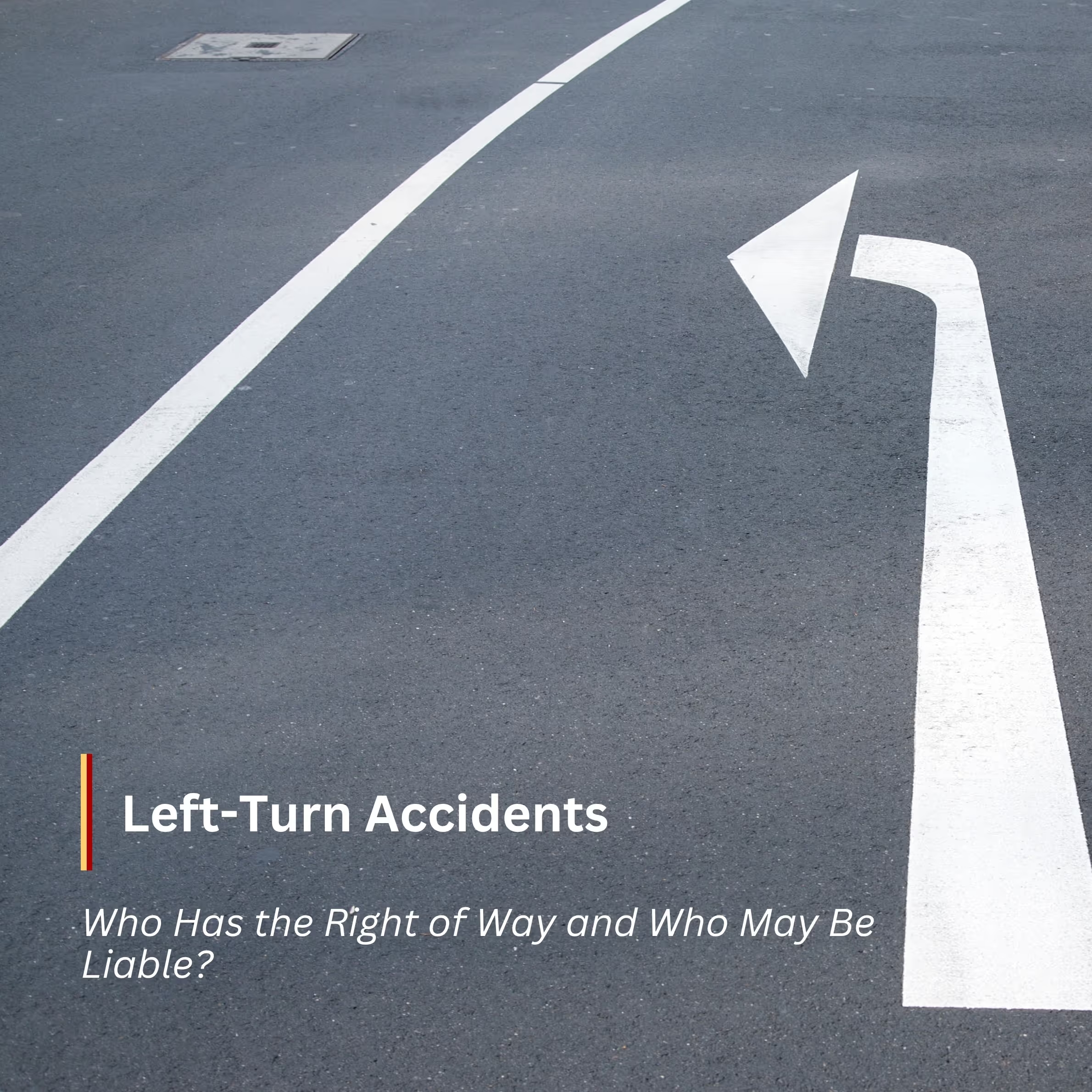
Left-turn accidents are one of the most common types of intersection collisions. They often happen when a driver attempts to turn across oncoming traffic and misjudges another vehicle's speed, distance, or right of way. Understanding the safety concerns of left-turn accidents and the necessary steps to take to prevent one is crucial for the safety of yourself and those around you.
A driver trying to turn left or make a U-turn must yield the right of way to vehicles approaching from the opposite direction that are close enough to cause harm. Before turning, drivers must ensure they can complete the motion with reasonable safety.
Once a driver has properly yielded and begun a proper left turn, approaching drivers must yield to the turning vehicle. However, having the right of way does not eliminate a driver's responsibility to exercise reasonable care. All drivers must remain attentive, follow traffic signals, and take reasonable precautions to avoid collisions.
Left-turn vehicle collisions can happen for several reasons, often involving a combination of driver behavior and roadway conditions.
1. Failure to Yield
One common cause is a driver turning left without allowing enough time for an approaching vehicle to pass. Misjudging the distance or speed of oncoming traffic can lead to a collision.
2. Distracted Driving
Drivers using mobile devices, adjusting navigation systems, or switching their attention may fail to notice approaching vehicles, pedestrians, or cyclists.
3. Speeding
An approaching driver traveling above the posted speed limit may reach an intersection sooner than the turning driver anticipates.
4. Running Red Lights
Accidents may occur when a driver enters an intersection after a traffic signal has turned red. In these situations, determining which driver violated the signal may be important.
In many left-turn accidents, the turning driver may be found responsible because California law usually requires that driver to yield to oncoming traffic. However, the left-turning driver is not automatically liable for every vehicle collision. Investigators and insurance companies may examine several factors when determining fault, including but not limited to the following.
Each accident must be evaluated according to its specific circumstances. A traffic violation may be relevant to liability, but the available evidence must also establish how the violation contributed to the collision.
California follows a comparative negligence system, meaning more than one driver may share responsibility for a vehicle collision. For instance, a driver making an unsafe left turn may be partially responsible, while an approaching driver who was speeding may also share fault. Under California's comparative fault principles, an injured person's compensation may be reduced according to their percentage of responsibility.
Left-turn accidents often involve impacts to the front or side of a vehicle. Depending on the speed and angle of the collision, drivers may experience various injuries, including but not limited to the following.
Some injuries may not become immediately visible after an accident. Seeking appropriate medical attention can help identify potential injuries and establish documentation of the symptoms and treatment received.
The following steps may be important considerations after a left-turn accident.
Seeking legal guidance and care may help victims move forward during a difficult time. A legal professional may review the facts of your case, speak to insurance companies on your behalf, and determine potentially responsible parties.
The personal injury team at KAASS LAW is ready to help victims understand their rights and responsibilities after being involved in a left-turn accident. It is important to take note that these types of collisions may cause serious injuries and create various challenges for victims and their families. If you have been involved in a left-turn vehicle collision, you are not alone. Call KAASS LAW today for a confidential consultation.
Learn about victims' legal rights after drunk driving accidents in California, including liability, compensation, insurance, and legal options.
Learn how fault is determined in California chain-reaction accidents, including shared liability, insurance claims, and available legal options.
Learn how vehicle recalls and defective car parts may affect accident claims, manufacturer liability, and legal rights under California law.