

According to California Penal Code Section 399.5, it is a crime to knowingly own a dog that is trained to attack, fight or kill and that the dog has bitten a person on two or more occasions, or the dog’s attack has caused serious injury. However, the same dog bite laws apply to animals that didn't have a training to attack.
California Penal Code 399 it is possible to be criminally charged for failing to control a dangerous animal. Therefore, the prosecution would have to show that the defendant willfully allowed a dangerous animal to roam; because of this, someone may sustain an injury or result death by the animal. California Penal Code 597 makes it a criminal offense to physically harm, overwork, neglect or kill an animal. This crime could include other crimes like dogfighting. In the state of California, we have a dog bite law that holds the owner of the dog accountable for all injuries sustained due to an attack by their dog, regardless of the dog’s prior behavioral history.
Violation of Penal Code 399.5 may result in different disciplinary outcomes because it is a wobbler offense. Therefore, misdemeanor or a felony can be changes for it.
Some penalties for a Penal Code 299.5 misdemeanor conviction include:
Some penalties for a Penal Code 299.5 felony conviction include:
Violation of Penal Code 399 is also another wobbler offense in California. If someone is killed because of failing to control a dangerous animal, it must be charged as a felony.
Violation of California’s dog bite law does not result in a prison sentence but makes the owner of the animal liable for all medical bills, lost wages, or pain and suffering caused to the victim of their dog’s attack.
A person charged with violating Penal Code 399.5 could possibly use one of the three following defenses to avoid charges:
Are you in need of legal assistance from a Los Angeles dog bite lawyer? You may contact KAASS Law at our phone number (310) 943-1171.

Invasion of privacy laws are both criminal and civil in California. They involve false light claims and cases involving the public disclosure of private facts. The laws are similar in that a person does something that invades another's privacy. While the specific activities in criminal and civil proceedings differ in terms of definitions and how they are proven, they are both intrusions on a person's personal affairs.
The California Privacy Act is a wiretapping law. It prohibits the recording of confidential conversations without the consent of all participants. This includes telephone conversations. Victims of illegal wiretapping may be subject to legal damages. Breaking the law is a crime. Violators may face:
During a telephone conversation, both parties must agree to record. Which makes California a "bilaterally agreed" state.
Examples of invasion of privacy are everywhere. We've all heard the story of a man whose ex-boyfriend or girlfriend shared risky photos without their consent. Social media platforms are regularly used as a launching pad for personal attacks. Many of us have probably even become the target of extremely harmful or violent "gossip" about someone's highly personal information. These are all examples of invasion of privacy, and they are all flagrant violations of people's right to maintain the confidentiality of their personal affairs.

California law defines the term assault as follows: an attempt to cause violent injury to someone. We can deduce from the definition that the victim does not need to get severe injuries for criminal liability to exist, thus. Significant harm is not a requirement for the crime to exist. California law distinguishes between different types of assaults, which have their specific elements of the crime. For instance, there are separate sections for assault with a firearm, assault with caustic chemicals, etc. Further, we will examine one assault by means likely to produce great bodily injury.
Under Penal Code Section 245 (a) (4), assault is defined as using force likely to produce great bodily injury to the victim. This section covers situations where an individual intentionally attempts to cause significant harm to someone else using force, and the potential for injury is severe.
As stated, this type of assault does not require actual injury to occur. Even if the victim is not injured or the injury occurs accidentally, charges can still be brought against the defendant. In other words, an assault charge under this section can be made if there is an attempt to cause harm through violent force, even if no physical injury is inflicted.
Being an accessory after the fact is illegal under Penal Code 32 PC. Its definition is knowingly harboring, concealing, or assisting a felon in order to keep them from being under the arrest. This is a crime that carries a maximum sentence of three years in state prison.
Under the legal regulations, accessory after the fact means the person who “harbored, concealed or aided" the person who committed the felony to assist him to escape punishment. As a result, the presence of the following factors must be present in order to understand when one can be guilty for committing this violation:
Fortunately, to qualify as a criminal annoying communication, a phone call, text message, or other communication must be more than just annoying. It must use filthy language or make threats, or it must be part of a series of harassing phone calls. The bad news is that determining what form of vulgar language or threats might lead to criminal liability for irritating phone calls is not always easy. The courts in California are still attempting to figure this out as well. This means that it may be difficult for someone to know whether or not what they're doing is illegal.
Making annoying phone calls and communicating with people is prohibited by law. Let's examine what are the criteria to define that communication is annoying;
We can conclude that there are several types of criminally annoying communication under the law;
Assault can take many forms under California law. However, one particularly dangerous and disturbing type is assault with caustic chemicals. This offense involves someone deliberately attempting to harm another person by throwing or placing harmful substances, such as acids or flammable liquids, on their body. Because these acts often result in serious physical and emotional trauma, the law takes them very seriously.
Under California Penal Code Section 244, assault with caustic chemicals occurs when someone willfully and maliciously throws, places, or causes a caustic chemical, corrosive substance, flammable material, or vitriol to come into contact with another person with the intent to injure or disfigure them.
The term caustic chemicals includes substances capable of burning or corroding human tissue. Common examples include:
Yes, under Health and Safety Code 11162.5, it is a crime to make or possess counterfeit prescription blanks for a controlled substance.
Controlled substance for purposes of Health and Safety Code 11162.5 is defined as those drugs or chemicals whose manufacture, possession, and use are regulated by the government under the United States “Controlled Substances Act.”
Under the code, counterfeit is defined as making an exact imitation of the prescription blank, pad, or form with the specific intent to use that prescription blank to defraud or deceive. These prescription blanks, pads, or forms are those that a physician or other medical practitioner who has the authority to prescribe medication typically uses when ordering or otherwise authorizing a prescription for a controlled substance.
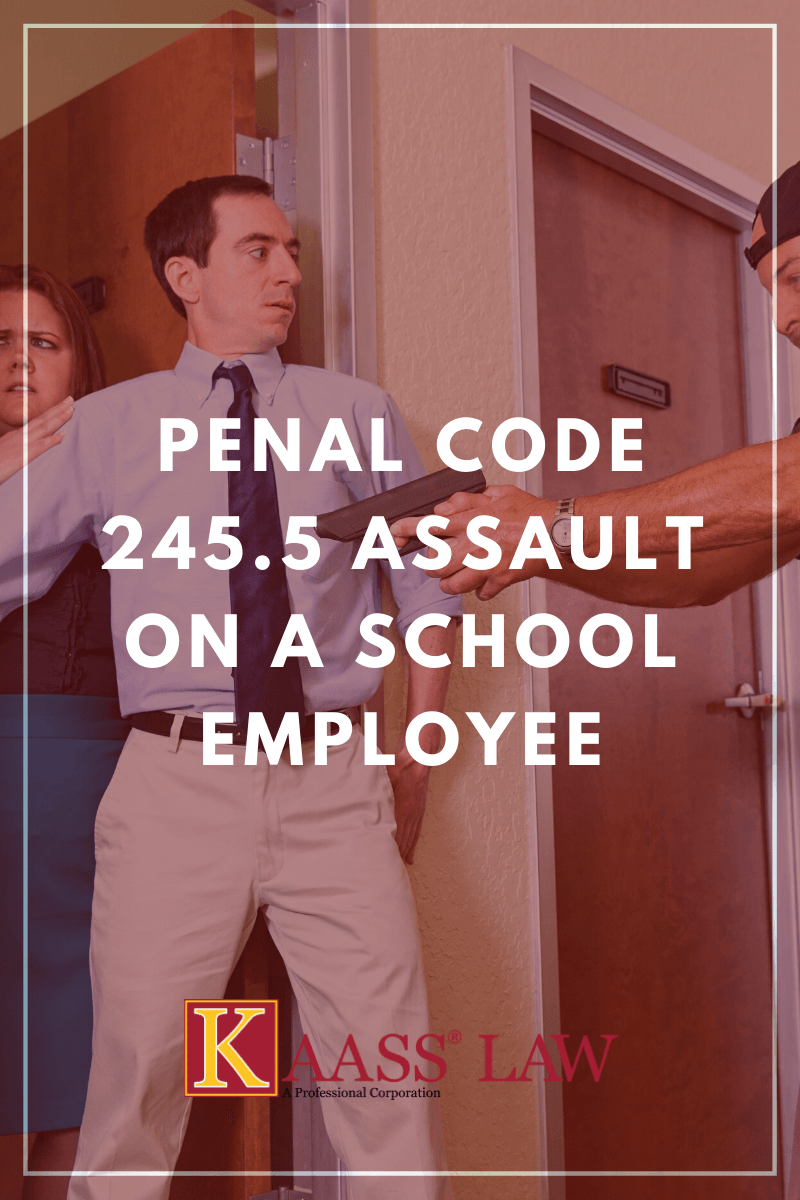
California law criminalizes the act of conducting "assault" and defines it as an unlawful attempt of a person to commit a violent injury to someone when there was a high ability to commit this injury. Teachers and other school employees enjoy high protection under state legislation. As such, California Penal Code section 245.5 PC is makes it a crime to assault of a school employee.
Under Penal Code section 245.5 PC the victim is the "school employee". A victim qualifies as a school employee if they are a permanent or probationary employee. This includes both full-time or part-time, including teachers, substitute teachers, and other administrative employees. For example, school bust drivers also fall under "school employees".
To be found guilty under PC 245.5, the prosecution must prove that:
Protection of minor's rights has always been one of the most important goals in any democratic society. Besides insurance of minor's rights, it has also been essential to criminalize and punish perpetrators of sexual abuse. Penal Code defines various types of sexual abuse of minors, including aggravated sexual assault of a child under Penal Code section 239 PC.
The crime defines committing "a certain offense" against a child. Special elements must exist to criminalize the action as aggravated sexual assault of a child. First is the age of the minor- the latter shall be under the age of 14. It means that children aged 14 or older cannot qualify as victims under this section. The second element is the age difference between the perpetrator and the victim. Under Penal Code section 239 the victim shall be seven or more years younger than the perpetrator. If this element is absent, the action will not qualify as aggravated sexual assault of a child. The third is the commitment of “the certain offense”. Not any sexual abuse of a minor under the age of 14 and with 7 or more years of age difference with the perpetrator shall fall under section 239. The listed crimes are rape, sodomy, oral copulation, and sexual penetration. Assaulting a child under Penal Code section 240 removes the third element since it’s not a “certain offense.”

Bump stocks laws are considered to be illegal both under federal law since March 2019 and under California law.
A bump stock is described as:
Thus, with the help of a bump stock, a shooter can shoot almost as fast as in case he uses an automatic firearm. Though it shall also be noted, that bump stocks do not convert semi-automatic guns into automatic ones.
The actions, which are considered illegal, are the following ones:
Typically, only living people can sue for invasion of privacy, which requires proof that public disclosure of a private fact has taken place. To prove this, it is necessary to establish five elements:
Public disclosure of information includes bringing information to the attention of the general public or a large group of people. A private fact is a detail of your life that is usually not open to others, such as your finances, sexual activity, or your health. When disclosure violates commonly held norms of decency, it is offensive to the typical individual. The disclosure that does not cause legitimate public concern is a disclosure that has no social value but deeply violates a person's privacy. Finally, demonstrating a reckless lie requires demonstrating that the defendant knew how offensive it would be to reveal private facts but did so anyway.
You may be hesitant to disclose a breach of your privacy due to feelings of vulnerability or even humiliation. However, remember that invasion of privacy is a felony that, like any other crime, must be prosecuted. Privacy invasions can range from innocuous to deadly, but no matter how serious they are, reporting them to the appropriate authorities as soon as possible is the best course of action. The consequences of defamation can be as serious as personal injury. As a result you deserve justice for the pain and embarrassment you are experiencing or did in the past.
If you or someone you know is subject to privacy invasion and have further issues, contact our Glendale personal injury lawyer today for a consultation and case review. If you have any questions please feel free to give our office a call at 310.943.1171.
To better understand Penal Code 245 (a) (4), we need to break down its essential components. The primary elements that define this assault charge include:
This section focuses on the potential for severe injury rather than the injury itself, making it different from other assault charges that may not involve the same degree of harm.
A crucial element that distinguishes this form of assault from others is the concept of "great bodily injury" (GBI). Great bodily injury refers to substantial or significant harm that severely impacts the victim's physical well-being. This can include:
The court will evaluate whether the injury qualifies as "great" based on various factors, including the severity of pain, the necessity for immediate medical care, and the long-term impact on the victim’s life. Minor or moderate injuries that do not result in major physical harm will not meet the threshold for great bodily injury.
It’s important to note that financial losses or emotional trauma do not qualify as great bodily injury under the law, as the term specifically refers to physical harm.
Assault by means likely to produce great bodily injury can include both as felony and misdemeanor under California Law. Depending on the facts of the case, the classification and sanctions may differ. The accused's criminal background, as well as the consequences of his or her actions. In the event that the actions are classified as a misdemeanor. The maximum penalty may be up to one year in county jail or a fine of not more than $10,000. If the crime is a felony, the penalties may include imprisonment in state prison for two, three, or four years.
An essential element for this type of assault is that the actions are likely to cause great bodily injury. Thus, the accused can prove that the possibility of great bodily injuries occurring was little. For example, if one threw an item at a victim who had little weight, the person couldn't sustain injuries from this action. Another way to defend against the penalties is by proving that the actions were conducted in self-defense. In this case, the act was willful, but there was no intent to cause great bodily injury to anyone.
These are possibilities in theory that can help with your defense, however, it is essential to have a professional lawyer to assist you and try to mitigate the penalties. If you have any questions, contact our Glendale personal injury lawyer today for a consultation and case review. Please feel free to give our office a call at 310.943.1171.
Let’s examine the following situation. In case you hide me in your house after I come and announce that I killed my colleague and lie to the police the next day that you have not seen me, you shall violate Section 32 of the California Penal Code. Other violation will be if you hide the gun by which I shot my colleague. Thus, hiding and/or destroying evidence, concealing the criminal, providing a false alibi, or any other assistance, are examples of actions that an “accessory after the fact” can commit.
Aider or abettor of the crime is one who participates in the crime with the perpetrator. Let’s examine the following situation. You can aider/abettor of the crime if me and you made a pact to murder a third person and you gave me a ride and also gave me the instrument of the crime. The distinction is that you were aware of the crime and had a role to play in it. In the case of Section 32 you became aware of the murder after it had occurred and aided me afterward.
Failure to reveal the crime generally means refusing to give any information about the crime. For example, in case you did not assist me the evening when I committed the crime of killing my colleague, and in the morning refused to tell anything about the crime to the police, this will not mean that you violated Section 32. Even if you were a witness of the crime and failed to speak about it this does not make you a perpetrator-you will be a mere bystander. Thus, while failing to provide any information has no negative implications, in order to be guilty, a person must knowingly help the criminal after the latter has violated the law.
A prosecutor has the option of charging the accessory after the fact with either a felony or a misdemeanor. Depending on the details of the case and the individual's criminal background. In both circumstances, the maximum penalties is $5,000. If the violation is a crime, you can spend up to three years in state prison. If you commit a misdemeanor, you can spend up to a year in a country jail.
In case you or your friend have been convicted for violation of the above mentioned legal regulations, then you may be entitled to compensation. Contact our Glendale personal injury lawyer today for a consultation and case review. Please feel free to give our office a call at 310.943.1171.
Besides the above mentioned, the law also qualifies as criminal such actions as not reaching the recipient but leaving a message to call back. In this case, when the recipient calls back and the person uses obscene language or threats in the phone conversation, this will be qualified as a violation under section 653m.
The most important element to criminalize the action is the presence of intent. This means that the person using this language or threatening shall have an intent to annoy or harass the recipient of the communication. For example, in case 2 friends in their usual conversations use “obscene” language. They argue, and after that one of them calls and texts again using this language. The other friend cannot claim that the use of obscene language, which has always been a usual element in their conversations, had the intent to harass him. Let’s also examine another situation. In case me and you have a common best friend and once we make a joke of calling and threatening to kill her the dog, and after several days we tell her about this joke, this will not be qualified as annoying calls and violation of the relevant section, as, there is no intent to annoy or harass our best friend.
The answer is again- the intent. For example, if every week you receive a call from an insurance company offering their new health insurance package, you cannot sue them for making annoying calls as they do not have the intent to annoy or harass you. Calling potential customers is their usual course of business.
Violation of section 653m is considered a misdemeanor. The punishment for such violation can be a conviction of up to six months in a country jail or a penalty in the amount of up to 1000 dollars. The defendant may also be sentenced to misdemeanor probation. As defense tools, it is possible to claim that the intent of communication was not to annoy or harass the person. Moreover, it is also possible to claim that the language was not really "obscene". Don't forget that anyone has a right to freedom of speech by the Constitution. Thus, sometimes, qualification of the communication as having "obscene" language can violate the constitutional right of a person.
Contact our Glendale attorney today for a consultation and case review. Please feel free to give our office a call at 310.943.1171.
These chemicals are often found in industrial cleaners, automotive fluids, and other household or commercial products.
Importantly, flammable liquids are also covered under this statute. To qualify, a substance must have a flashpoint of 150°F or less, meaning it can ignite quickly and inflict serious harm when misused.
To secure a conviction under Penal Code 244, prosecutors must demonstrate four essential elements beyond a reasonable doubt. These elements, as explained in CALCRIM 877 Jury Instructions, are:
Intent is a critical factor in these cases. The law applies only when the accused deliberately uses a harmful substance to injure or disfigure another individual.
Suppose someone, trying to escape a robber, tosses a liquid to distract them. If the liquid unintentionally contains acid and injures the robber, the person may not be guilty under Section 244. There was no intent to disfigure or injure, which is a necessary element of the offense.
In contrast, imagine a woman in an argument with her neighbor throws a chemical in their face while yelling insults. If the chemical causes burns or scarring, and there’s evidence of intent to harm, prosecutors are likely to charge her with felony assault under this statute.
Because of the severe potential consequences, this offense is classified as a felony in California. Penalties include:
If probation is granted, the court may impose additional conditions such as:
Although these charges are serious, several valid defenses may apply. Some common strategies include:
If the defendant had no intention to harm or disfigure the other person, the charges may not stand. Accidental contact, even if harmful, does not satisfy the required intent.
If the accused acted to prevent imminent harm to themselves or another person, that justified use of force can be a strong defense.
Mistakes can happen. For example, if someone accidentally spilled a chemical while handling it responsibly, that does not amount to an assault.
Several other California laws may be charged alongside or instead of Penal Code 244, including:
If you’re facing a felony charge for assault with caustic chemicals, don’t wait. The stakes are high, and early legal representation can significantly impact your case outcome. A knowledgeable criminal defense attorney can evaluate the evidence, protect your rights, and advocate for the best possible resolution.
On the other hand, if you were injured by someone else’s use of caustic chemicals, you may have a valid personal injury claim. Victims often face long-term medical treatments, lost wages, and emotional trauma. The attorneys at KAASS LAW help victims seek compensation for:
Call us today at (310) 943-1171 for a free consultation.
Learn more here: KAASS LAW – Glendale Personal Injury Lawyer
Assault with caustic chemicals is among the most serious forms of assault in California. Defined under Penal Code Section 244, it requires a clear intent to injure or disfigure using harmful substances. Whether you’re facing charges or were injured in such an attack, understanding the law—and taking action—can make all the difference.
The penalties associated with violating this code can be prosecuted as either a misdemeanor or felony and is therefore considered a wobbler offense. Potential penalties for a misdemeanor Health and Safety Code 11162.5 conviction including up to one year in county jail as well as paying fines of up to $1,000. Potential penalties for a felony Health and Safety Code 11162.5 conviction include sixteen (16) months, two years, or three years in county jail.
The number of counterfeit prescription blanks is typically what determines whether the violation will be charged as a misdemeanor or felony. For example, if the individual has three or fewer counterfeit prescription blanks, the violation would likely be charged as a misdemeanor. On the other hand, should the individual possess more than three, the violation will likely be charged as a felony.
If you or someone you know has been charged with violation of Health and Safety Code 11162.5, please contact KAASS LAW today at (310) 943-1171 to speak to our criminal defense attorneys for a free consultation.
To be charged and convicted under this offense, the school employee must be performing their employment duties at the time of the offense. Thus, if the assault occurs in the evening while the teacher is walking in the park with his dog, the defendant cannot face charges under Penal Code section 245.5.
Penal Code 245.5 PC makes it a crime to assault a school employee with a deadly weapon, a firearm, or a stun gun or taser or by any other means likely to produce great bodily injury upon the person of a school employee. Penal Code 245.5 PC can result in either a misdemeanor or a felony charge.
Penalties for a 245.5 PC conviction vary based on the type of weapon used during the assault.
If the defendant used a deadly weapon, other than a firearm, the penalties include imprisonment in the state prison for 3, 4 or a maximum of 5 years of imprisonment in jail for up to one year.
If the defendant used a firearm while conducting the assault, the penalties include imprisonment in state prison for 4,6 or 8 years of imprisonment in jail for up to one year.
In the event the defendant used a stun gun or a taser, the penalties include imprisonment in state prison for 2, 3, or 4 years of imprisonment in a country jail for up to one year.
Defendants charged under section 245.5 may have several defenses. One such defense is lack of intent. If the defendant:
The defense can argue that the assault was not intentional. In addition, the defense of necessity may be used. If the defendant acted in response to an immediate threat to his or her health or life.
If the defendant accused of assaulting a school employee pleads guilty, or if there are mitigating circumstances, the defense may request a reduced sentence. This may include suggestions for alternative action. Such as:
It is important to note that the court's decision will largely depend on:
Punishment for the crime of assaulting a school employee can have a significant impact on the defendant's career. Especially if he or she works in education. A charge under Section 245.5 may result in:
And other professional consequences that may limit future employment opportunities.
It is important to contact an experienced attorney who specializes in criminal cases. A defense attorney will be able to:
If you or a loved one is facing charges under California Penal Code Section 245.5, do not delay in consulting with a qualified attorney.
It is essential to consult with a Los Angeles criminal defense attorney to try to mitigate the punishment for the commitment of the assault. We invite you to contact our criminal defense attorney today at (310) 943-1171 for a free consultation and case review.
California punishes aggravated sexual assault of a child as a felony with a minimum sentence of 15 years to life in state prison. The criminal can also face consecutive prison terms, which means that the latter can face sentences under section 239 back to back. A Penal Code 239 PC conviction also requires registering as a sex offender.
Besides the negative reaction of the society and public contempt and hatred, registration as a sex offender interferes with several rights of a person such as the right of freedom of movement, right to privacy, right to work, and several other protected rights by the Constitution. Each State in the US has its separate database for registration of the sex offenders. This means that in case the sex offender changes the state where he lives, he shall each time register in the database of the state he moved to and become subject of legislation of that state concerning sex offenders. Thus, relocation to a new state will not help to avoid the consequences of such registration. The sex offender can also face difficulties in employment. After conviction, there can be limitations to work in certain places which are near schools or kindergartens.
In 2006, California adopted "Jessica's Law", a ballot initiative that prohibits registered sex offenders from living within 2,000 feet of a school, park or similar location where children gather. As such, often times California registered sex offenders may have a difficult time finding suitable tenancy. Thus, besides long imprisonment, registration as a sex offender and remaining as it unless the court determines otherwise, can limit and restrict many of the rights of the offender and leave negative consequences in his life after conviction.
A conviction for aggravated sexual abuse of a child under California Penal Code Section 239 has serious and lasting consequences. Individuals found guilty are required to register with the state as sex offenders. However, the legal and social consequences do not end there 1. Registration as a sex offender significantly limits housing options. Under Jessica's Law, a person on the registry cannot live within 2,000 feet of where children are typically found. As a result, convicted offenders may be denied rental housing. Even in populated areas, it is extremely difficult to find housing. 2. Convicts face employment restrictions. For example, they cannot hold positions that involve working with minors. This includes positions in the following areas:
The existence of a criminal record under article 239 automatically excludes the possibility of employment in government and licensed organizations. that require security clearance. 3. Registering as a sex offender makes it difficult to move to another state. Federal regulations require a registrant to re-register with the appropriate database in the new state within a specified time frame. Failure to do so may result in additional criminal liability. In summary, a conviction under Section 239 not only deprives one of liberty, but also comes with numerous consequences. which limit basic constitutional rights and make further social rehabilitation much more difficult.
If you or a loved one has been charged with Aggravated sexual assault of a child or other related crime, we invite you to contact KAASS LAW at (310) 943-1171 for a free constellation and case review.
There are a handful of people and or entities whom are legally allowed to possess a bump stock. The people and or entities whom are entitled to legally possess a bump stock include the following:
It is to be noted that those listed above must have a permit in order to have the right to possess bump stocks.
The offense is a wobbler offense, thus, depending on the facts and criminal history of the defendant, it can be charged either as a felony or a misdemeanor.
The penalties for a Penal Code 32900 misdemeanor conviction include imprisonment in a county jail for a term of up to one year.
The penalties for a Penal Code 32900 felony conviction include imprisonment in a county jail for 18 months to three years.
Since March 2019, bump stocks are considered to be a type of machine gun and are also illegal under Federal Law. Bump stock owners need to destroy them or transfer them to law enforcement agencies. Possessing a bump stock can lead to the following penalties under federal law:
There are some common defenses for Penal Code section 32900, which are possible to use in order to avoid penalties. Examples of such are:
If you or a loved one has been charged with Penal Code 16930 we invite you to contact our Los Angeles criminal defense attorney today at (310) 943-1171 for a free consolation and case review. We are located at 815 E. Colorado Street Unit 220, Glendale, CA 91205 with additional offices in Los Angeles located at 633 West 5th St., 26th Floor, Los Angeles, CA 90071.