
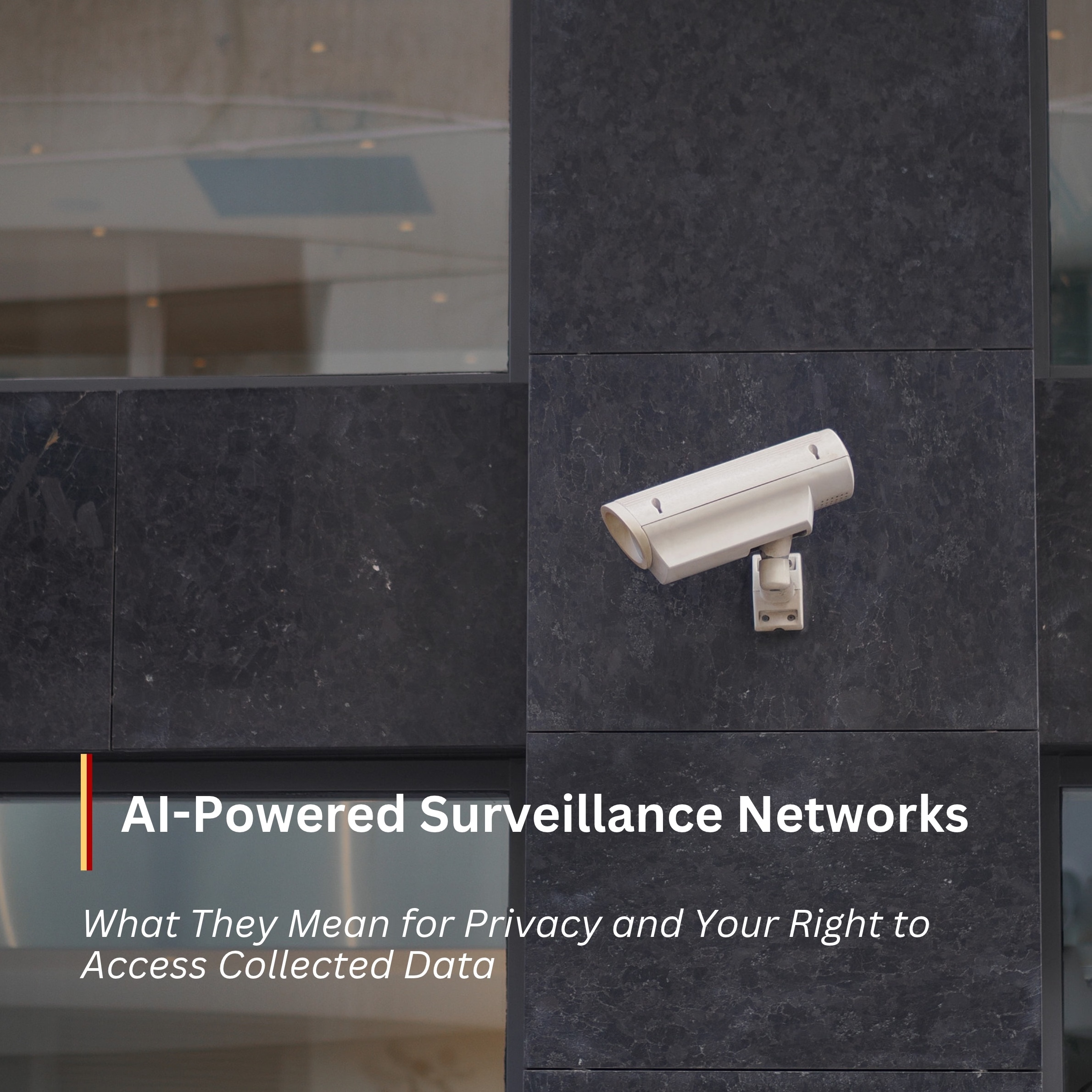
AI-Powered Surveillance Networks: An Overview
Artificial intelligence is changing how law enforcement monitors public spaces. Across the United States, police departments and municipalities are increasingly using AI-powered surveillance networks to identify vehicles, investigate crimes, and collect information about people's movements.
Companies such as Flock Safety provide automated license plate recognition (ALPR) systems that capture vehicle information and store it in searchable databases. For California residents, understanding the distinction between federal information laws and state privacy protections is especially important moving forward.
AI-powered surveillance networks combine cameras, automated image recognition, databases, and computer algorithms to collect and analyze information. Automated license plate readers can capture a vehicle's license plate number, make, model, color, location, and time of observation. Some systems can also identify specific vehicle characteristics that may help law enforcement understand the aftermath of an accident, investigate stolen vehicles, or even locate missing people.
Many individuals are wondering how the world will change as there has been a significant increase in Flock Safety cameras. When surveillance systems retain vehicle observations over time, they may reveal information involving someone's workplace, medical appointments, religious activities, or personal relationships.
The federal Freedom of Information Act, codified at 5 U.S.C. § 552, generally allows individuals to request existing records maintained or controlled by federal executive branch agencies. However, federal agencies may withhold certain information under exemptions involving law enforcement investigations, personal privacy, or other protected interests.
California residents may request certain government records through the California Public Records Act (CPRA). The CPRA usually provides public access to government records unless a statutory exemption or other legal restriction applies.
Depending on the circumstances, individuals may request surveillance-related records, including but not limited to the following.
However, access to individual vehicle tracking records may be restricted because releasing those records could expose sensitive information about other people.
California Civil Code §§ 1798.90.51–1798.90.55 establish requirements for automated license plate recognition systems. These requirements address data security, authorized access, privacy policies, and restrictions on information sharing.
Under Civil Code § 1798.90.51, ALPR operators must maintain reasonable security safeguards and make their usage and privacy policies publicly available.
Additionally, Civil Code § 1798.90.52 requires operators to maintain records identifying when information is accessed, who accessed it, and the purpose of that access.
Whether surveillance violates constitutional protections depends on the technology, the information collected, and how government authorities use it. In addition, the presence of surveillance cameras on public roads does not automatically establish a constitutional violation.
Individuals concerned about government surveillance may take several steps to understand how information is collected and used.
For California state or local government records, individuals may submit a CPRA request identifying the specific documents they may need. These requests may include surveillance contracts, data-sharing agreements, access policies, and retention schedules.
1. Can I request footage or license plate information collected by Flock Safety cameras?
You may request records held by a government agency under applicable public records laws. However, privacy exemptions and other restrictions may limit disclosure of individual vehicle records.
2. Can police track my vehicle without a warrant?
Automated license plate scanning does not always require a warrant. However, constitutional questions may arise depending on the nature, duration, and extent of tracking.
3. Can I sue if my surveillance information is misused?
California law provides remedies for certain harmful violations involving ALPR information. Whether legal action is appropriate depends on the specific facts.
4. Are AI surveillance cameras illegal in California?
Automated surveillance cameras are not completely prohibited, but their operation, data access, and information sharing must align with applicable laws.
Individuals who believe their information has been improperly accessed or disclosed may wish to preserve relevant documentation and seek legal guidance. A legal professional may review the specific facts of your case, preserve important information moving forward, and determine potentially liable parties.
AI-powered surveillance networks raise developing questions involving government transparency, privacy protections, and access to public records. KAASS LAW is determined to help individuals and businesses in Los Angeles, Glendale, Pasadena, and surrounding Southern California communities.
Individuals concerned about surveillance-related legal issues may contact KAASS LAW to request a consultation regarding their circumstances and available legal options. A qualified attorney can assess whether applicable public records laws, privacy protections, or other legal provisions may be relevant to a specific situation. Call KAASS LAW today to learn more.
All of the apps and online services you use track, collect and distribute your usage patterns and demographic information. However, some companies put much more emphasis on protecting the data of their consumers, whereas others go out of their way to collect and analyze as much of their users’ data as they can. The ever-increasing gap between companies’ ethos and philosophy toward user privacy has reached a turning point. On the one hand, you have companies like Apple that have built up a brand and a reputation for standing with their customers by protecting and encrypting their data as much as possible–at times even making that data completely inaccessible to Apple itself. Then again, on the other hand, you have companies like Google that go out of their way to gather as much data and information as possible from their users, without paying nearly as much thought as to how to contain and protect that data from breaches and hacks. As a consumer, these increasingly polarized attitudes and approaches toward the issue of privacy should definitely strike a chord, and at least raise some questions for thought.
One of the questions that might come to mind is whether or not you actually have any say as to how often or what kinds of data companies can collect from you. Unfortunately, the answer isn’t as cut and dry as a yes or no. The reality is that privacy laws vary immensely depending on the industry, type of service, and location of the company providing the app you are using. As such, the level of accountability and transparency that businesses must meet are quite different from one another. What this means in real world situations is that a customer cannot have universal demands or expectations from businesses and companies regarding their privacy. While this is hugely inconvenient, there is a silver lining in the form of your own decision making. Though you alone cannot control the laws governing the ins and outs of these companies, you can make an educated decision as to which services you choose to use and to what extent you wish to use them.
For example, upon creating an account for Gmail, Twitter, Facebook iCloud and the like, you will typically be presented with a series of options regarding data and diagnostics. While most folks usually just take the easy route and skip ahead using the default settings, it is definitely worth your time to stick around and explore a bit. By taking a second look at what you are agreeing to, you may notice a couple of things that genuinely surprise you. It’s amazing how much these companies can get away with gathering from your usage and many people probably would not be as comfortable using those services, if they understood the extent of the access these companies have regarding your private data. By taking a couple of minutes and reading up on your options while signing up, you can actually limit several major pieces of information that these companies have access to, such as browsing and crash data, frequency of use, and general statistics about your areas of interest and demographics.
As for the things you cannot control, there is little else you can do about that outside of finding another company that provides a similar service that values your privacy more than its data collection. Some things you can’t easily limit access to include anything the company exempts or says it needs from you in order to provide their service in their privacy policy and anything else that they can gather ‘publicly’ from your browsing or usage. Certain bits of information are personal but not identifiable, meaning that they cannot see who the data is from nor any identifying characteristics of the user. While it can definitely be scary to think of all the data these companies have collected from you, you should know that usually the data is only used internally. What this means is the company that collected your data while you used their app or service will only use that data to improve the quality and performance of their site or product. The upside of this is your data will not be pawned off to other companies, but the downside is that less and less businesses give you that level of privacy as an option.
The classic example of a company that is more than willing to sell and barter away their gathered information is Facebook. To be clear, Facebook is a company which has millions of active users and their database of users is quite diverse, covering many different spheres and communities. As such one would think that Facebook would understand and value their users’ privacy by respecting and protecting it...but no. Facebook instead takes the much more lowly route of simply hoarding as much user data as possible and then selling this data to third party companies for a massive markup and profit. Perhaps the most insulting aspect of this shady business practice is that it happens almost entirely in total secrecy, without any notice or heads up given to any of the user base. As a result of their recklessness, Facebook CEO Mark Zuckerberg has had to appear before Congress to explain the company’s actions and decision making processes, especially in light of recent hacks and security breaks which have exposed millions of users’ profiles, photos, friend lists, and other private data without their permission.
In light of these now public scandals, most consumers have reached a point where they just want to enjoy the services they need without a constant fear of being tracked and the worry of having their collected information leaked publicly. For your own privacy and security, we recommend to do some searching around to see if the particular apps and services you use have strong options for limiting the amount of data that can be gathered from your activity, as well as checking up on the overall reputation of that company as it is relevant to user privacy. Even a simple internet search can bring up any major scandals, side deals, security breaches, and common privacy concerns regarding any given company. By checking out some articles like this one here, you can learn so much more about how your data and privacy are treated on the internet and what you can do about it on your end.
Our goal here is to empower you with some of the basics regarding your rights to privacy and how data collection works on different platforms. At KAASS LAW, we stand with our clients and we believe that privacy is a right, not a privilege. If you have any other questions or concerns regarding your online privacy and how you can take control of it, don’t hesitate to get in touch with us. We invite you to reach out to us with any problems or cases you may have by giving us a toll free call at (310) 943-1171 to speak to one of our lawyers today.